
India has achieved a significant milestone in its energy transition, with non-fossil fuel sources now accounting for 50% of the nation’s total installed power generation capacity. This feat has been accomplished five years ahead of its committed 2030 deadline under the Nationally Determined Contributions (NDCs) to the Paris Agreement, as announced by the Federal Ministry of New and Renewable Energy.
The total non-fossil capacity has surged to 242.8 GW, precisely half of India’s overall installed capacity of 484.8 GW. This substantial contribution is diversified, comprising 184.62 GW from renewable power, 49.38 GW from large hydro projects, and 8.78 GW from nuclear power. Federal Minister for New and Renewable Energy, Pralhad Joshi, expressed national pride on social media, highlighting India’s role as a leader in global climate solutions.
This achievement holds profound significance given the government’s ambitious targets: installing a total of 500 GW of non-fossil capacity by 2030 and striving for net-zero carbon emissions by 2070. India’s progress is particularly noteworthy on the global stage. Despite having one of the lowest per capita emissions worldwide, India stands out among the few G20 countries that are not only on track but are exceeding their NDC commitments.
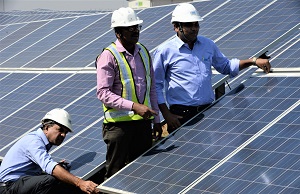
The ministry emphasized India’s consistent advocacy for climate equity, sustainable lifestyles, and low-carbon development pathways at international forums such as the G20 and COP – Conference of the Parties which is the annual meeting of the UNFCCC parties (The United Nations Framework Convention on Climate Change) to negotiate and implement global climate policy and action.
By reaching the 50% non-fossil milestone ahead of schedule, India solidifies its position as a front runner in clean energy, demonstrating that robust economic growth can indeed go hand-in-hand with diligent environmental stewardship.
Looking ahead, India faces the challenge of managing escalating power demand, which touched a record 250 GW in May last year and is projected to hit 270 GW this year. To address grid stability concerns posed by intermittent solar and wind energy, the government is actively promoting energy storage systems. The Central Electricity Authority (CEA) has already advised co-locating energy storage with solar projects to enhance efficiency and grid stability, further cementing India’s comprehensive approach to a sustainable energy future.
Last updated: December 26th, 2025

