

For decades, American companies could treat India as a market to consider someday. That era, speakers at a recent Southern California business gathering made clear, is over.
Across three conversations — with India’s Consul General, a manufacturer that built a plant in Pune in 14 months, and an engineer whose firms helped build the Delhi Metro — one message emerged: for companies serious about growth, supply-chain resilience, and the technologies of the next decade, India is no longer optional.
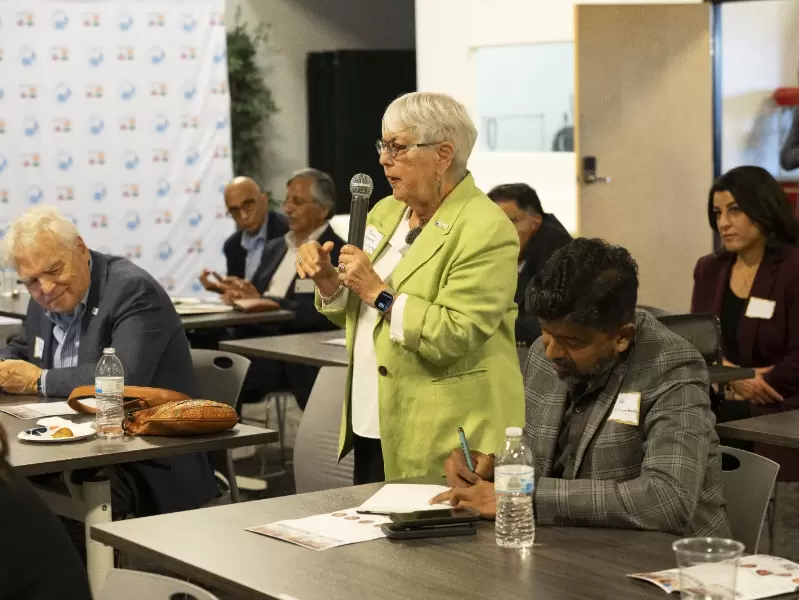
Organized by the California India Chamber of Commerce, the event was held in Irvine, California on June 25th, 2026 and attracted executives from medical devices, aerospace, biopharma, defense, trade logistics and more
The Consul General’s Case
In a fireside chat moderated by Gunjan Bagla, who runs a consulting firm helping companies do business in India, Consul General Dr. K.J. Srinivasa framed India not as an emerging market but as a strategic partner shaping the global economy.
The numbers he cited speak for themselves: the world’s fastest-growing large economy at roughly 7% annually, on track to become the third largest within a few years; a middle class of some 600 million — roughly the population of Western Europe; the world’s third-largest startup ecosystem; and 2030 Paris climate goals achieved five years early.
On the long-awaited U.S.-India Bilateral Trade Agreement, Dr. Srinivasa said negotiations are down to “the commas and full stops,” with the $500 billion bilateral trade target spanning defense, aerospace, pharmaceuticals, and services — flowing in both directions. Despite media portrayals of strained tariff talks, he noted, not a single planned collaboration missed a date over the past two years. He called U.S.-India ties “the most consequential relationship of the 21st century.”
The Consul General sees Southern California as strategically distinct from the Bay Area, with strengths in defense, aerospace, semiconductors, logistics, biotech, clean energy, and quantum computing. A centerpiece of his agenda is a proposed India-U.S. “talent corridor,” with funded exchange programs, R&D funding, and a dedicated task force — its first planning meeting is set for next month.
He also pointed to momentum on the ground: over $48 billion in data-center commitments from Microsoft, Google, and Amazon; a $3–5 billion surge in Indian drone orders following the May 2025 clash with Pakistan; and India’s fast breeder reactor achieving criticality after three decades of research.

