
From Presidential Visits to Boardroom Decisions
What strikes me, looking back across the history of U.S. presidential visits to India, is how closely political alignment has tracked commercial reality. Each visit reduced friction; each milestone normalized trust. Over time, what was once a diplomatic curiosity became a business inevitability. Since Bill Clinton’s landmark trip in 2000, India has risen from America’s 25th largest trading partner to one of its top ten.
Today, American companies don’t ask me whether India matters. They ask how to engage without missteps—how to build, source, invest, and scale in a market that is strategic, complex, and moving fast. This perspective is what led us to build Amritt: a firm focused on helping companies succeed in India across boardrooms, factories, and government offices.
As we approach #PresidentsDay in the United States, let’s look back at the leaders who paved this path over the last 79 years. (And the time I accompanied one as part of an Executive Mission to #Mumbai and #Delhi.)
India gained independence from British Rule in 1947. It took another 12 years before an American President arrived on its shores.
Dwight D Eisenhower – 1959
Dwight Eisenhower in 1959 was the first U.S. president to visit India. His visit was during the tenure of the country’s first Prime Minister Jawaharlal Nehru.
During his trip, “Ike” addressed both houses of the Indian Parliament and visited the Taj Mahal with Prime Minister Nehru. The trip marked a significant shift in the perspective of many in Washington, who had not been happy with India’s preference to be a non-aligned country.
John Kennedy had warm feelings for India but did not visit the country during his short tenure as President. First Lady Jackie Kennedy made a “goodwill” tour of India and Pakistan in March 1962. Kennedy did send John Kenneth Galbraith as Ambassador. Galbraith fell in love with the country and decades later was awarded one of India’s highest civilian honors.
Richard M Nixon – 1969
Nixon’s one-day trip to India was primarily aimed at de-escalating tensions with Prime Minister Indira Gandhi. The two leaders had a frosty relationship because of India’s decision not to take sides in the Cold War and the U.S. decision to deepen its partnership with India’s fascist neighbor Pakistan. (The U.S supplied Patton tanks and Saber jets to Pakistan’s military both of which were deployed in wars against India. Even today Pakistan has a fleet of American F-16 fighter jets)
Two years later, the relationship soured further when Nixon supported Pakistan in the India-Pakistan War of 1971, which led to the creation of Bangladesh. Nixon and Kissinger authorized the Seventh Fleet including the U.S.S. Enterprise to enter the Bay of Bengal. The war was massive but short, only 13 days. India’s Army and Air Force overwhelmed the beleaguered 93,000 soldiers, who were largely from West Pakistan and took them all as prisoners of war. Lieutenant-General A.A.K. Niazi surrendered to his Indian counterpart Lt. General JS Arora on December 16, 1971 well before the American flotilla reached close to the war zone. The damage caused by Nixon and Kissinger to US-India relations still lives on Indian memory. When Kissinger died in 2023, most media in India carried negative stories about him.
Jimmy Carter – 1978
Jimmy Carter came to India in January 1978 with first lady Rosalynn Carter, when the Janata Party’s Morarji Desai was the prime minister.
During his three-day visit, Carter addressed India’s parliament and held several meetings with Indian politicians. The visit was preceded by Carter’s mother “Miss Lillian”, who had served as a Peace Corps volunteer in Mumbai several years earlier. Enthusiastic Indians in the north renamed a village to Carterpuri.
Neither Ronald Reagan nor George HW Bush felt the need to visit India. There was a 22- year gap before another POTUS would touch India’s shores. During this time India vastly liberalized its economy in 1991 and began a rapid growth path that has kept up to this day.
Bill Clinton – 2000
Bill Clinton’s India trip – the first by a U.S. President for more than 20 years – was a landmark one that came after this prolonged lull in the relations between the two countries. He was accompanied by his daughter, Chelsea Clinton. After Clinton, every POTUS has spent time in India.
Clinton’s visit signified the beginning of closer US-India strategic and economic ties. During the 1999 Kargil conflict, the U.S. under Clinton sided with India, the first time it had supported India against Pakistan. Clinton also visited Mumbai where he gave a speech at the Bombay Stock Exchange, something that was inconceivable in years past.
I landed in Delhi shortly after Air Force One that March. It was quite a sight to see the aircraft as we taxied to the terminal. A few days later, I was in Jaipur and our hotel was fully occupied by American security personnel. The parking lot had huge antennas. And next week, I visited Mumbai – where the main highway from the Airport to downtown was shut down for hours so POTUS could have a clear pathway (this was the last time that India would do this).
After leaving office, both Bill and his wife Hillary have visited India as a private citizens, and Hillary also visited as Secretary of State.
Business and geo-politics have brought both countries closer together each year since 2000. Common adversaries – terrorism and China – have also bound America and India regardless of party power for the US Presidency, House, or Senate, or the party power in New Delhi.
George W Bush – 2006
George W Bush visited New Delhi and Hyderabad in 2006. By this time, America has started to de-couple its thinking and separating India relations from any conversation with Pakistan. The attacks of September 11, 2001 had shown to the White House that alignment with India, which had suffered many incidents at the hand of foreign terrorists, could be a friend and partner.
In late 2008, at the height of the U.S. financial crisis, Bush and Indian Prime Minister Dr. Manmohan Singh signed the “123” Civil Nuclear Agreement which opened the doors to nuclear energy trade between India and the world. Singh would later call this agreement his greatest achievement. Later in life, Bush took to painting and made a great portrait of Dr. Singh.
Barack Obama – 2010 and 2015
Barack Obama visited India twice, the first President to do so while in office. During his first trip in 2010 during the administration of Prime Minister Manmohan Singh, he backed India’s bid for a permanent seat in the United Nations Security Council. An executive mission consisting of American business leaders accompanied the President. I was the only person from California to be part of the trip. Obama arrived in Mumbai the day after Diwali (the festival of lights) and went on to Delhi later.
On Diwali night I left my brother’s home in Delhi and took an almost empty flight to Mumbai, landing in the midst of a city lit up with fireworks. I had a radio interview scheduled with National Public Radio Station KCRW and traffic was so heavy that I had to start the interview from the limo! Security at the hotel was tight but they knew I was arriving and I sailed through the X-Ray check with only a five second blip. I completed the rest of the interview in the lobby of the hotel (while a number of burly plain clothes Secret Service men pretended to walk their dogs sniffing every corner). Here’s a link to the radio show.
Obama visited India again in 2015 as the chief guest on Republic Day under the administration of Prime Minister Modi.
Obama said this in a speech to the public “I realize that the sight of an American President as your chief guest on Republic Day would have once seemed unimaginable. But my visit reflects the possibilities of a new moment. As I’ve said many times, I believe that the relationship between India and the United States can be one of the defining partnerships of this century.”
At a personal level, “Barry” Obama had an Indian-origin apartment mate when he was a student at Occidental College here in the Los Angeles area – that is when he acquired an affinity for “dal” and began carrying a tiny statue of Hanuman with him at all times. Obama also held a kind of Town Hall with Indian students, something that India would not have encouraged of past Presidents.
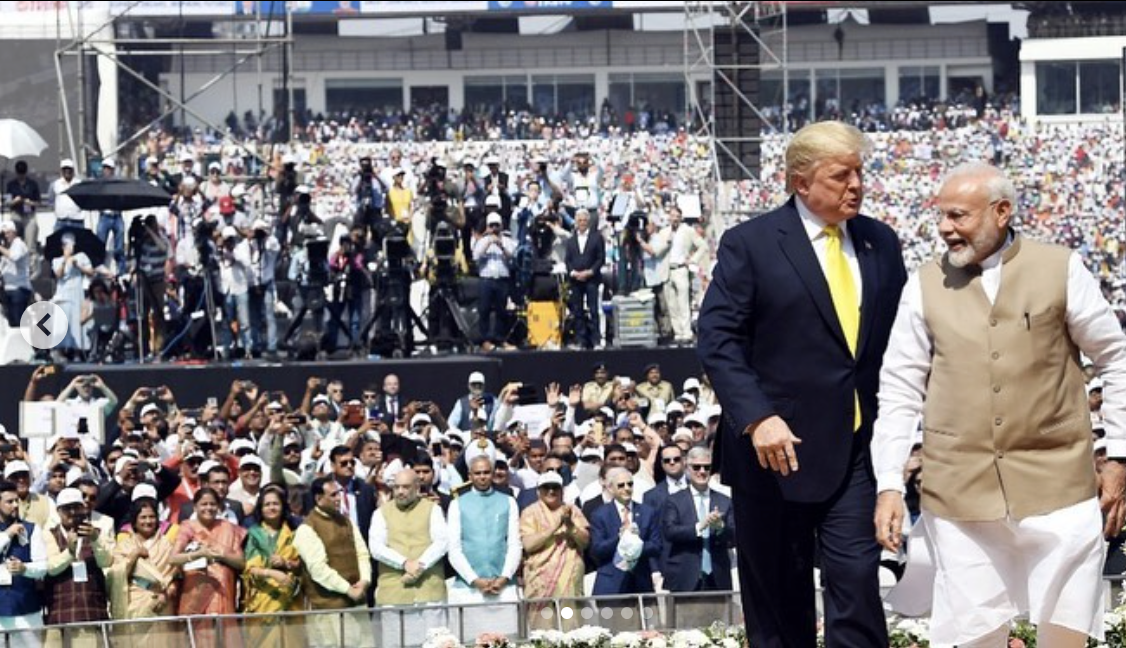
Donald Trump – 2020
Donald Trump along with first lady Melania Trump, was the seventh US president to visit India, where he was given a warm welcome. Their daughter Ivanka Trump also visited with them.
A personal rapport had developed between Indian Prime Minister Modi and Trump. The President landed in Ahmedabad, the home state of Narendra Modi. He then went on Delhi and to Agra to visit the Taj Mahal with the first lady. (Obama has planned to visit with his wife but had to change plans at the last minute).
Joe Biden – 2023
As Obama’s Vice President, Joe and Jill Biden had visited Mumbai around 2015, where he disclosed that some Indian Bidens had once reached out to him (he seemed incredulous at that time, but once he was elected President, Indian media was able to locate the said “desi” Bidens). Biden also challenged Indian companies to think about a half-billion dollar bilateral trade target – which seemed equally incredulous but is now within range.
Biden also hosted Indian Prime Minister Narendra Modi in Washington in June 2023 and then followed up with a visit to New Delhi in September. 2023 was the year that US-India relations – business, political, cultural reached their highest level in 77 years.
Looking ahead – 2026 and Beyond
President Donald Trump was invited to return to India for India’s Republic Day, January 26. 2026, but was unable to make it. This was likely due to the pending trade struggles which are now on the way to be being resolved. I expect that he will return to India later this year when New Delhi hosts the Quad Summit.

