
Westinghouse Electric Company has set an ambitious goal for India: as many as 18 of its AP1000 nuclear reactors operating in the country by 2047.
If realized, the program would represent roughly 20 gigawatts of new generating capacity and make the American nuclear technology company a significant participant in India’s plan to dramatically expand nuclear power over the next two decades.
“We aspire to have 18 AP1000 plants in India by 2047,” Alok Mishra, Country Director for Westinghouse Nuclear India, said at a policy discussion organized by India Infrastructure Finance Company Limited (IIFCL) and The Energy and Resources Institute (TERI). Mishra said Westinghouse is already talking with private Indian companies about multiple plants at multiple locations.
The timing could be important. India has established a national goal of reaching 100 GW of nuclear generating capacity by 2047, compared with just 8.78 GW today. The government’s roadmap calls for about 54 GW to come from Nuclear Power Corporation of India Limited (NPCIL), while the remaining 46 GW could involve other government entities, state governments, private companies and joint ventures. Recent changes in Indian law have explicitly opened the sector to greater private participation.
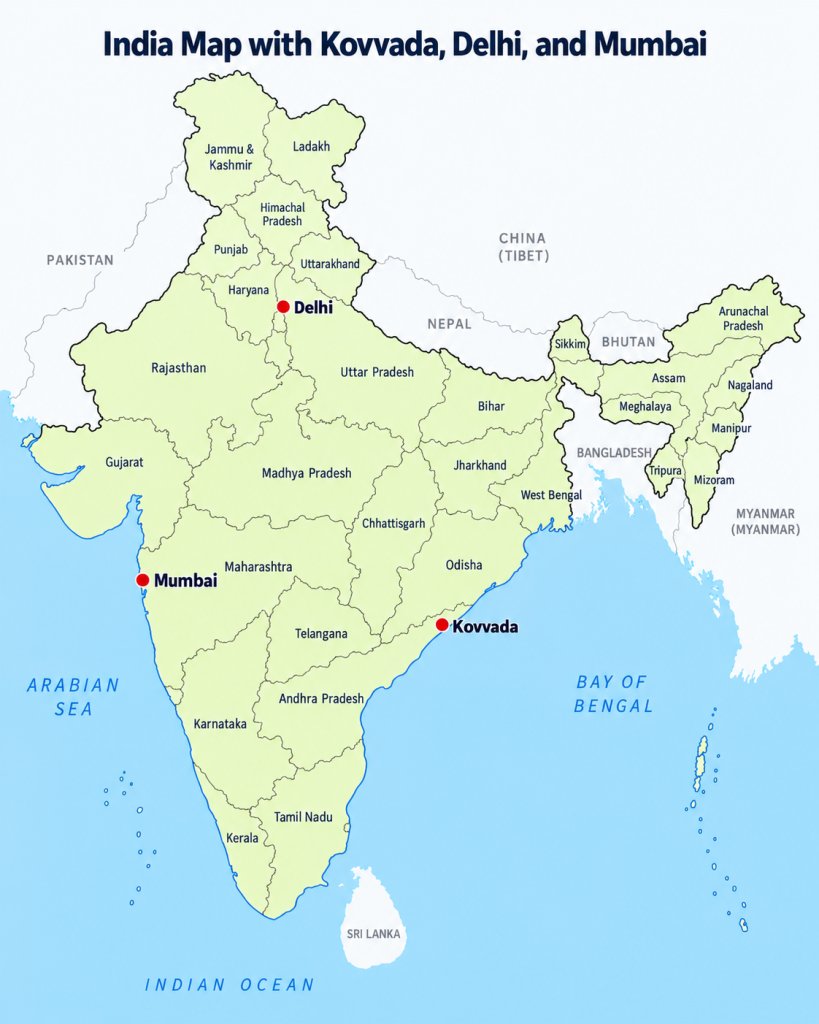
Starting With Kovvada
Over 15 years ago the Indian government tagged Kovvada in the southern state of Andhra Pradesh as the first site for these AP1000 reactors but no contracts were signed due in part to global concerns about India’s liability law (which was revoked and replaced with the Shanti Act in December 2025).
The proposed plants would each have a net electrical output of about 1,110 MW. According to media reports, discussions between Westinghouse and the Indian government have covered such issues as the division of responsibilities, nuclear liability and pre-construction activities.
Westinghouse’s larger India vision now appears to extend well beyond Kovvada.
Manufacturing the Reactors in India
Perhaps the most interesting aspect for American businesses is Westinghouse’s emphasis on localization. Mishra said the company is exploring technology transfer and wants to use India’s existing nuclear manufacturing capabilities. Some qualified Indian suppliers could eventually become part of Westinghouse’s global supply chain.
That could create opportunities across heavy engineering, precision manufacturing, specialized materials, pumps and valves, instrumentation and controls, construction, engineering services and other nuclear-qualified products.
Westinghouse also believes the AP1000’s relatively simplified design can help control costs. The pressurized water reactor uses passive safety systems and fewer components than conventional designs, reducing requirements for equipment, cabling and nuclear-grade building space, according to the company.
The technology is no longer theoretical. Six AP1000 reactors are operating commercially—four in China and two at Plant Vogtle in Georgia—and another 14 were under construction globally as of July 2026.
For U.S. nuclear companies, Westinghouse’s plans illustrate the scale of the opportunity emerging in India. But India’s 100-GW target, new opening to private participation suggest that the country could become one of the world’s largest nuclear-energy markets over the next two decades.
(Note: Westinghouse is a former client of Amritt Inc. All information in this blog post is from public/media sources only)
Sources
Westinghouse Electric Company, AP1000 Reactor Design.
Government of India, Department of Atomic Energy, Nuclear Energy Mission, July 22, 2026.
Government of India, Department of Atomic Energy, Kovvada project status.
Business Today, “Westinghouse plans 18 nuclear power plants in India by 2047,” September 10, 2026.

