
For large industrial projects, equipment failure after installation can be extraordinarily expensive. A problem discovered at a refinery, petrochemical complex, or power plant can delay commissioning, disrupt production and require engineers to troubleshoot machinery thousands of miles from the factory.
Triveni Turbine Limited of India took an unusually comprehensive approach to a recent 60-MW steam turbine-generator project for a major oil and gas customer in the Middle East: it tested the entire rotating equipment train together before the package left its manufacturing facility in India.
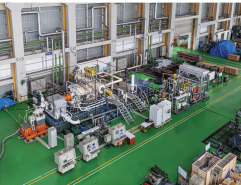
Instead of validating the steam turbine, gearbox and generator independently, Triveni assembled them into a complete operating train and connected the system to a dynamometer that allowed engineers to simulate load conditions. The goal was straightforward: identify potential problems in the factory rather than at the customer’s site.
From Component Testing to System Testing
The industrial turbine, gearbox, generator, couplings, lubrication system and other equipment function as one interconnected system. A vibration or alignment issue in one component can affect the performance and reliability of the entire installation.
For the 60-MW project, Triveni therefore began with a full-train rotor-dynamic analysis covering the turbine rotor, gearbox, pinion and generator. Engineers also analyzed torsional behavior—the forces created as torque moves through the connected shafts.
The work was performed in accordance with API 612 requirements, an important American Petroleum Institute standard used for special-purpose steam turbines in petroleum, petrochemical and gas applications.
Triveni then built a test configuration capable of operating the turbine, gearbox, generator and dynamometer as a single machine train. That required specialized foundations, lubrication systems and instrumentation capable of continuously monitoring the equipment during testing.
One important result was vibration performance. Shaft vibration remained below 20 microns, comfortably within the applicable API 612 acceptance limit.
Why It Matters to Project Owners
The technical achievement is significant, but the larger business lesson is simpler.
Large capital projects increasingly depend on complex equipment packages assembled from multiple interacting systems. Testing each component separately may not reveal problems that emerge only after those components are connected.
By validating the complete train before shipment, manufacturers can compare actual operating behavior against their engineering models and identify potential integration issues while the equipment is still in a controlled factory environment.
For owners and EPC contractors, that can mean fewer surprises during installation, greater confidence during commissioning and lower risk of costly schedule disruptions.
Triveni’s test program included a full-speed, no-load mechanical run followed by part-load validation using the dynamometer. The company reported successful confirmation of the machine train’s torsional and rotor-dynamic performance, stable operation under high-flow conditions and vibration levels within API requirements.
For Western companies evaluating global suppliers of sophisticated industrial equipment, the takeaway is worth noting. Manufacturing capability is no longer defined simply by whether a supplier can build a large machine. Increasingly, the differentiator is whether that supplier has the engineering expertise, test infrastructure and quality systems to demonstrate—before shipment—that the complete system will work as designed.

