
Adani Ports and Special Economic Zone Ltd. secured a $1.4 billion investment from Mediterranean Shipping Co. (MSC), marking a boost for India’s port infrastructure. MSC’s terminal arm, Terminal Investment Ltd., will invest $539 million upfront in Adani’s Vizhinjam Port, followed by $858 million upon completion of expansion in 2028.
The Mediterranean Shipping Company S.A., branded as MSC, is an international shipping line part of MSC Group that operates 524 offices in 155 countries with its headquarters in Geneva, Switzerland, and has over 200,000 employees.
The Vizhinjam, Kerala deepwater transshipment hub, located near India’s southern tip, is scaling up capacity from 1.6 million TEUs (twenty-foot equivalent units) to 5.7 million TEUs, enabling it to handle the world’s largest container ships.
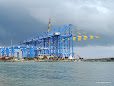
MSC will hold a 49% stake, while Adani retains majority control.
Vizhinjam will reduce India’s reliance on foreign ports which currently handle about 75% of its transshipped cargo. In the last fiscal year, the port managed 1.3 million TEUs , including 70 ultra-large vessels — the highest among Indian ports.
Adani Ports CEO Ashwani Gupta emphasized that the partnership will enhance global supply chain efficiency and strengthen India’s access to key markets.
Global Trade Impact of this Deal:
Shifting Trade Routes
The expansion of Vizhinjam Port positions India to capture some of the cargo flows that traditionally move through Colombo, Dubai, and Singapore.
Strategic Stakes
MSC’s 49% stake signals confidence in India’s logistics future. For global shippers, this means:
- More direct calls to Indian ports.
- Lower transshipment costs.
- Diversification of routing options away from congested Middle Eastern and Southeast Asian hubs.
India’s Trade Leverage
Vizhinjam’s natural depth and upgraded infrastructure can strengthen India’s bargaining power in global supply chains. This is particularly relevant for U.S. importers sourcing from South Asia, as it could shorten transit times and reduce costs.
Market Confidence
The timing matters: MSC’s investment follows the resolution of U.S. charges against Gautam Adani, restoring investor confidence in the conglomerate. For global markets, this underscores how regulatory clarity can unlock capital flows into emerging infrastructure.
Why It Matters for U.S. Businesses:
- Supply chain resilience: More diversified shipping routes reduce exposure to choke points.
- Cost efficiency: Direct calls to India could lower freight costs for U.S. importers.
- Strategic competition: India’s rise as a transshipment hub challenges China’s dominance in regional logistics.

