
India’s long delayed Prototype Fast Breeder Reactor (PFBR), a 500 MWe nuclear energy facility at Kalpakkam, Tamil Nadu, has achieved first criticality last month. This marks the point where the reactor core began sustaining a controlled fission chain reaction. The technology for this reactor was developed entirely in India.
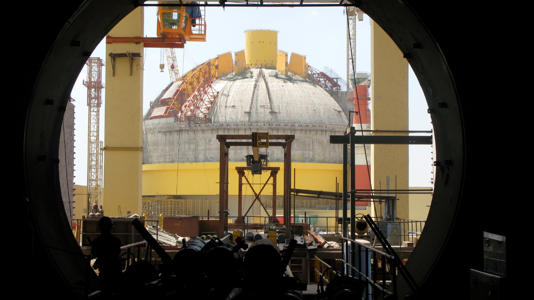
The PFBR places India among a select group of nations operating fast breeder reactors at this scale. It represents the second stage of India’s three-stage nuclear program, designed to eventually harness thorium reserves.
- Design & Development:
- The reactor was designed by the Indira Gandhi Center for Atomic Research (IGCAR) and built by Bharatiya Nabhikiya Vidyut Nigam Ltd (BHAVINI), both under the Department of Atomic Energy (DAE). Construction began in 2004, with delays attributed to “first-of-a-kind technological issues.”
- Fuel Cycle: The PFBR uses mixed oxide (MOX) fuel of uranium-238 and plutonium-239, with liquid sodium coolant. It is engineered to produce more fissile fuel than it consumes, converting uranium-238 into plutonium-239 and potentially thorium-232 into uranium-233, achieving a thorium-based closed nuclear fuel cycle.
- This configuration allows the reactor to convert fertile material into fissile fuel during operation.
- Regulatory Clearance: The Atomic Energy Regulatory Board (AERB) authorized the First Approach to Criticality when the reactor core begun sustaining a controlled fission process in 2024 after rigorous safety reviews.

