
On August 23, India became the first country to successfully land near the moon’s south pole. Since touchdown, India’s moon lander and rover have made some important discoveries.
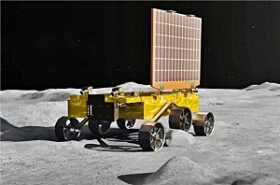
One of the rover’s first discoveries was confirming the presence of sulfur on the lunar surface. Up until then, orbiting satellites were not able to identify sulfur on the moon’s surface the Indian Space Research Organization (ISRO) said.
The rover deployed its Laser-Induced Breakdown Spectroscopy instrument to fire intense laser pulses at the lunar surface. The laser generated a hot, bright plasma. Scientists then studied the light from that plasma and identified the presence of sulfur.
The rover has also detected the presence of aluminum, calcium, iron, chromium, and titanium. ISRO said it is searching for the presence of hydrogen. Its discoveries will help scientists figure out how to mine water on the moon, an advancement that would be critical for future lunar bases.
Per The Planetary Society, the lunar poles are some of the most water-rich regions on the moon. They contain enough water ice to fill at least 240,000 Olympic-sized swimming pools.
Three days after landing on the moon, the Instrument for Lunar Seismic Activity (ILSA) payload on the lander detected significant vibrations on the lunar surface which are being analyzed by the scientists at ISRO.
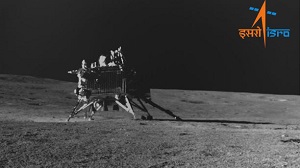
The lander has also measured the soil temperature near the lunar south pole both on the surface and underground, for the first time. The probe measured 3 inches into the soil, and found it was about 140 degrees F colder than at the surface. On lunar days the sunlight from doesn’t penetrate into the layers beneath the lunar surface. This phenomenon is something you can observe on Earth too, Paul Hayne, a planetary scientist at University of Colorado Boulder, told Nature.
My brother Pallava Bagla, an journalist who writes about India’s space exploration, told Al Jazeera that India doesn’t have access to technology that withstands temperatures less than -184 Fahrenheit. Nighttime temperatures on the moon have been measured as low as -334 Fahrenheit, according to NASA.
Another device on the lander called the Langmuir Probe, which helps characterize plasma, has been able to measure the density and temperature of the moon’s ionosphere for the first time.
Last updated: December 26th, 2025

