
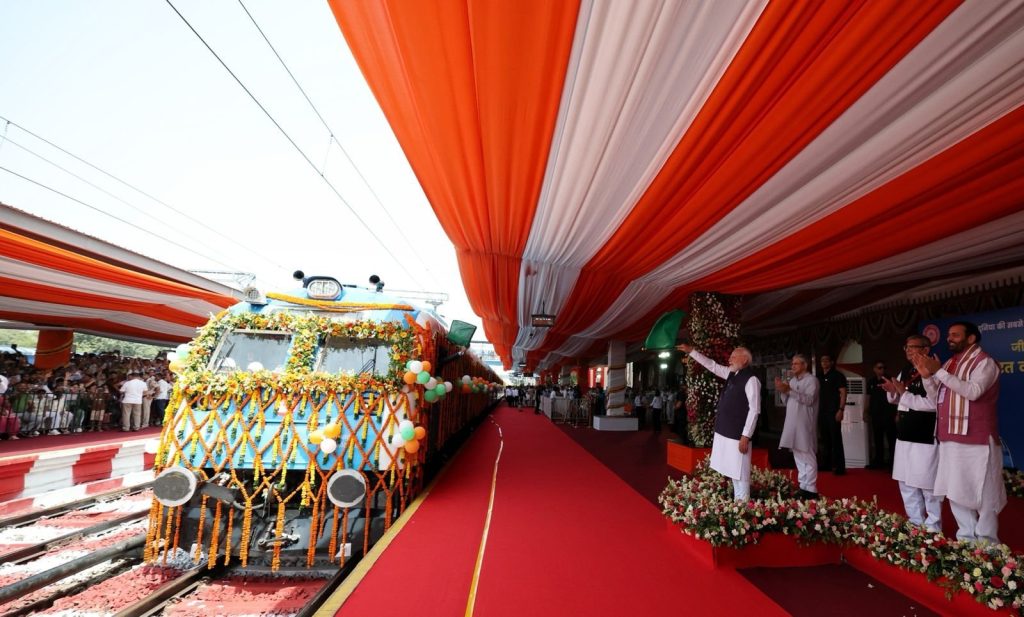
India took a notable step toward greener rail travel on Friday, launching its first hydrogen-powered train—a locomotive designed, engineered, and built entirely within the country. The debut adds India to a small club of nations experimenting with the technology and signals where the world’s fourth-largest rail network wants to head next.
Prime Minister Narendra Modi flagged off the train, dubbed the “NaMo Green Rail,” at the Jind railway station in the northern state of Haryana. (“NaMo” is a familiar shorthand drawn from his first and last names.) On X, Modi called it a milestone for self-reliant India and sustainable development, and said the country would keep looking for ways to run its railways more efficiently, cut costs, and grow the network. Indian Railways in a unit of the India’s Central or Federal Government and merits its own cabinet ministry.
How the train works
Unlike a conventional diesel or electric engine, this train runs on hydrogen fuel cells. The cells produce electricity by combining hydrogen and oxygen, and the only thing that comes out the other end is water vapor and heat, similar to the Toyota Mirai automobile. That makes it a much cleaner option than diesel, particularly on routes that haven’t been fully electrified.
The setup is a 10-car configuration: two driving power cars carrying the fuel cell systems, plus eight passenger coaches. Each power car delivers 1,200 kilowatts, giving the train a combined output of 2,400 kilowatts. It can hold roughly 2,600 passengers.
For now, it’s cleared to run at a top speed of 75 kilometers per hour (about 47 mph), though the design allows for speeds up to 110 kph. The whole thing was carried from the drawing board through prototype manufacturing inside India, which is a big part of why officials are treating the launch as a point of national pride.
Where it runs
The train covers the roughly 89-kilometer (55-mile) stretch between Jind and Sonipat in Haryana, the state that borders the national capital, Delhi. It makes the trip twice a day.
On the outbound leg, service number 74010 leaves Jind at 7:40 a.m. and pulls into Sonipat at 9:40 a.m. Coming back, service 74009 departs Sonipat at 10:40 a.m. and reaches Jind at 1:00 p.m. Along the way, the route links Jind Junction, Gohana Junction, and Sonipat, with stops at a string of smaller stations in between—places like Jind City, Pandu Pindara, Mohana, and Barwasni, among others.
To keep the train running, the pilot project comes bundled with its own hydrogen infrastructure: dedicated storage and refueling facilities built to test how the technology holds up in real service. A government statement described the effort as pairing advanced propulsion with the storage, refueling, and operational systems needed to support it.
A pilot with bigger ambitions
This first train is very much a test case, over a short route. India wants to see how hydrogen performs on the ground before deciding how far to take it, and the Jind-Sonipat run will serve as a proving ground for future eco-friendly service.
The launch fits into a larger climate agenda. India has already electrified nearly all of its 70,000-kilometer (43,500-mile) broad-gauge network—one of the largest in the world—as part of a push to reach net-zero carbon emissions in its railways by 2030. That railway target sits inside a broader national goal of hitting net-zero emissions by 2070. Hydrogen gives the country another tool for the corners of the network where full electrification doesn’t make as much sense (as long as Hydrogen can available in those parts.
Not the first, but in good company
India isn’t breaking entirely new ground here. Germany, Japan, China, and the United States have all rolled out hydrogen-powered trains, and Germany got there first—its Alstom Coradia iLint became the world’s first hydrogen-powered passenger train in service.
What makes India’s version stand out is that it was built at home, from the ground up, rather than imported or licensed. In a country that runs one of the busiest and most sprawling rail systems on the planet, that self-sufficiency carries real weight.
The bottom line
A single train on a short route in Haryana won’t decarbonize Indian Railways overnight. But the NaMo Green Rail is less about this one line than about what it represents: proof that India can build hydrogen trains itself, and a working laboratory for figuring out whether the technology deserves a bigger role. If the pilot delivers, expect to see a lot more hydrogen humming along India’s tracks in the years ahead.

