The AI Impact Summit 2026 will take place from February 16–20 in New Delhi. Positioned as the first major global AI gathering hosted in the Global South, the event aims to transition international discussions into actionable development outcomes. The summit is anchored by three foundational “Sutras” or pillars: People, Planet, and Progress, and organized around seven “Chakras” or working groups of multilateral cooperation, including human capital, social empowerment, and safe AI.
Key Event Details
Dates: February 16–20, 2026.
Venue: Bharat Mandapam, New Delhi, India.
Registration: Open via the official website. Official reports clarify there are no registration fees or participation charges for the summit or its associated challenges.
Scope: Over 700 sessions covering AI safety, governance, data protection, and sovereign AI.
Summit Agenda and Objectives
The program focuses on aligning AI advancement with national priorities such as the IndiaAI Mission. Working groups co-chaired by representatives from the Global North and South will present deliverables such as:
Proposals for AI Commons and shared compute infrastructure.
Trusted AI tools and sector-specific use cases for healthcare, agriculture, and education.
Sustainable, energy-efficient AI solutions to foster economic growth.
Prime Minister Narendra Modi will lead the formal opening ceremony on February 19, followed by a high-level CEO roundtable.
Notable Attendees
The summit features an assembly of global tech executives and AI researchers:
| Category | Confirmed Attendees |
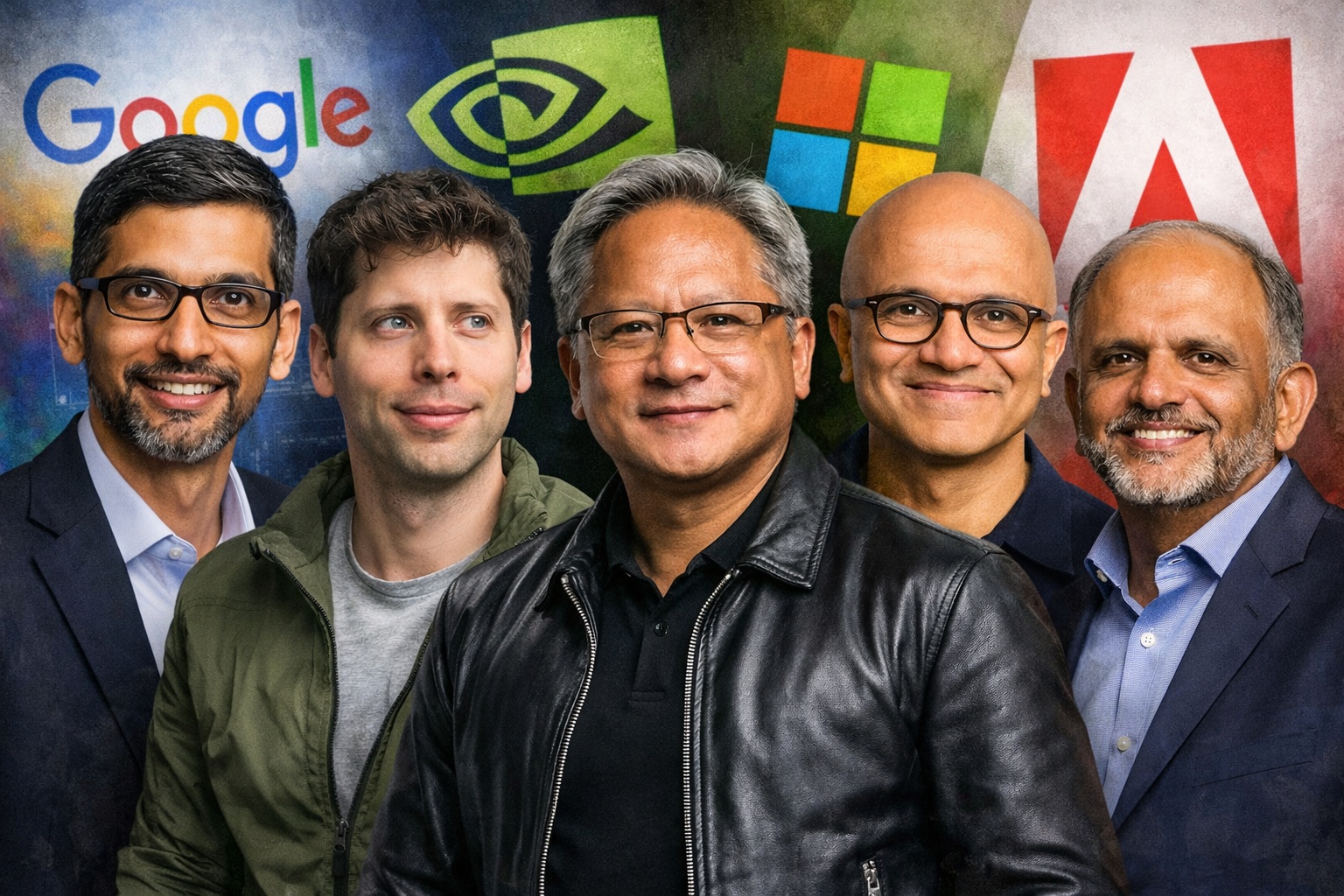
| Global Tech CEOs | Sundar Pichai (Alphabet), Sam Altman (OpenAI), Jensen Huang (Nvidia), Satya Nadella (Microsoft), Shantanu Narayen (Adobe) |
| AI Pioneers | Demis Hassabis (Google DeepMind), Yann LeCun (Meta/AMI Labs), Yoshua Bengio, Stuart Russell |
| IndiaAI Mission | |
| Global Executives | Bill Gates (Microsoft founder), Julie Sweet (Accenture), Cristiano Amon (Qualcomm), Brad Smith (Microsoft President) |
Here are brief biographies for the industry leaders based on their career achievements as of early 2026.
Alphabet CEO – Sundar Pichai
Sundar Pichai joined Google in 2004 and was instrumental in developing the Chrome browser before becoming the CEO of Google in 2015 and Alphabet in 2019. Under his leadership, the company transitioned to an “AI-first” focus, integrating advanced machine learning across global products such as Search, Workspace, and Android. He is recognized for his engineering-centric approach and for scaling Google’s cloud and hardware businesses.
OpenAI CEO – Sam Altman
Sam Altman is an entrepreneur who formerly served as the president of the startup accelerator Y Combinator before co-founding OpenAI. As CEO, he has led the organization through the releases of GPT-4 and ChatGPT, positioning OpenAI at the forefront of the generative AI boom. He is a central figure in global discussions regarding AI governance, safety, and the potential for Artificial General Intelligence (AGI).
Nvidia CEO – Jensen Huang
Jensen Huang co-founded Nvidia in 1993 and has served as its CEO since its inception, overseeing its transformation from a gaming graphics company to an AI powerhouse. He is credited with anticipating the rise of accelerated computing, leading the development of the CUDA platform and the GPUs that now power most of the world’s AI models. Under his leadership, Nvidia has become one of the most valuable companies in the world due to its foundational role in AI infrastructure.
Microsoft Founder – Bill Gates
Bill Gates co-founded Microsoft in 1975, a move that revolutionized personal computing and made him an influential figure in modern history. After stepping down from daily operations in 2008, his focus was on global philanthropy through the Bill & Melinda Gates Foundation, tackling issues such as climate change and infectious diseases. While no longer CEO, he remains a key advisor to Microsoft and a leading public voice on the societal and ethical implications of AI.
Google DeepMind CEO – Demis Hassabis
Sir Demis Hassabis is a British computer scientist and co-founder of DeepMind, which was acquired by Google in 2014 to lead its most advanced AI research. A former child chess prodigy and game developer, he guided breakthroughs such as AlphaGo and the Nobel Prize-winning AlphaFold, which solved the challenge of protein structure prediction. He currently serves as the CEO of the unified Google DeepMind unit, focusing on building safe and general-purpose AI systems.
Anthropic CEO – Dario Amodei
Dario Amodei is the CEO and co-founder of Anthropic, an AI safety and research company established after he and several colleagues left OpenAI. He is a former physicist and senior research executive who played a key role in the development of GPT-2 and GPT-3, with a specific expertise in “alignment”— ensuring AI systems act in accordance with human values. Under his leadership, Anthropic has developed the Claude model family, known for its emphasis on “Constitutional AI” and steerability.
Mistral AI CEO – Arthur Mensch
Arthur Mensch is a French AI researcher and entrepreneur who co-founded Mistral AI in 2023 after serving as a researcher at Google DeepMind. He has positioned Mistral as Europe’s leading AI champion, advocating for open-weights models and “sovereign” AI technologies. Mensch is a graduate of École Polytechnique and is influential in European policy debates regarding the balance between AI regulation and innovation.
Adobe CEO – Shantanu Narayen
Shantanu Narayen has been the CEO of Adobe since 2007, famously leading the company’s transition from a traditional software licensing model to a cloud-based subscription service. He successfully integrated AI into Adobe’s Creative Cloud suite through the Firefly family of generative models, focusing on “content authenticity” and enterprise-safe creative tools. Narayen is known for his strategic consistency and for maintaining Adobe’s dominance in the digital media and marketing industries.
Accenture CEO – Julie Sweet
Julie Sweet is the Chair and CEO of Accenture, where she leads a global workforce in helping enterprises navigate digital and AI-driven transformations. She has committed billions of dollars to the firm’s AI practice, emphasizing a “human-centric” approach where AI augments rather than replaces workers. Sweet is a former lawyer and a member of various international business councils, frequently speaking at the World Economic Forum on the necessity of responsible AI scaling.
Qualcomm CEO – Cristiano Amon
Cristiano Amon, an electrical engineer by training, became the CEO of Qualcomm in 2021 after decades of leading the company’s 4G and 5G wireless strategies. He has spearheaded Qualcomm’s diversification beyond smartphones into automotive and PC markets, positioning Snapdragon processors as the “on-device AI” engine for the next generation of hardware. Amon is focused on the “intelligent edge,” where AI processing happens locally on devices rather than entirely in the cloud.
Palo Alto Networks CEO – Nikesh Arora
Nikesh Arora is the Chairman and CEO of Palo Alto Networks, a role he assumed in 2018 after executive stints at Google and SoftBank. He has overseen a transformation of the company from a hardware-centric firewall provider to an AI-driven cybersecurity platform through acquisitions and innovation. Arora is a leading advocate for “Precision AI” in security, arguing that the speed of modern cyber threats requires autonomous, AI-driven defense systems.