
According to Linda Yueh‘s article On the Prosperity of Countries, emerging and developing economies for the first time account for a larger share of world GDP or global output than developed economies.
The World Bank estimates that of the 101 middle-income economies in 1960, just a dozen or so had become prosperous by 2008:Equatorial Guinea, Greece, Hong Kong SAR (China), Ireland, Israel, Japan, Mauritius, Portugal, Puerto Rico, South Korea, Singapore, Spain, and Taiwan.
Research by the Organization for Economic Co-operation and Development estimates that by 2030, for the first time in history, more than half of the world’s population will be middle class.
Based on current trends, in 2030 around two-thirds of the middle classes worldwide – nearly 3 billion people – will be in Asia. The UN describes it as a historic shift not seen for 150 years.
In the early 1990s, China, India, and Eastern Europe changed course. China and India re-oriented their economies outward to integrate with the world economy, while Eastern Europe shed the old communist institutions and adopted market economies.
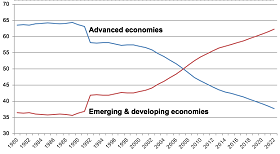
The 1990s witnessed the rapid growth of emerging economies whose growth via industrialization eventually led to an extraordinary commodity super-cycle due to their voracious demand for raw materials to fuel their development. It took the fall of the Berlin Wall, the rescue of India by the IMF in 1991 as well as China’s re-orientation towards the global economy in 1992 for these economies to look to adopt a new course. These successes point to the advantages of looking beyond the economic staples of capital, labor, and technology in fashioning growth policies.
Last updated: December 26th, 2025

