
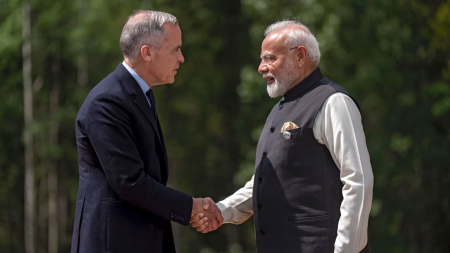
In early 2026, Canadian Prime Minister Mark Carney conducted a high-level visit to Mumbai and New Delhi, marking the first such visit by a Canadian leader since 2018. The mission focused on diversifying Canada’s global partnerships by aligning with India’s rapidly growing economy. The two nations have committed to a series of initiatives aimed at transforming their respective economies through cooperation in energy, technology, and human capital. This engagement follows a year of intensified diplomatic activity, resulting in over $5.5 billion in new commercial agreements and a shared roadmap for long-term bilateral growth.
Trade and Investment
Canada and India have committed to concluding a Comprehensive Economic Partnership Agreement (CEPA) within the current year. This agreement is designed to more than double two-way trade, with a target of $70 billion by 2030. Currently, Canadian investment in India exceeds $110 billion. During the visit, Prime Minister Carney engaged with Indian business leaders representing $600 billion in market capitalization to promote Canada as a destination for global capital, particularly in infrastructure and manufacturing.
Energy Partnership
The two nations launched a New Energy Partnership to address India’s rising energy demand and Canada’s capacity as an energy exporter. Key developments include:
Nuclear Energy: A $2.6 billion agreement for Saskatchewan-based Cameco to supply 22 million pounds of uranium to India through 2035.
Renewables and Fuel: Canada will join the International Solar Alliance and transition to full membership in the Global Biofuels Alliance.
Hydrocarbons: Negotiations are underway for Canada’s first long-term Liquefied Petroleum Gas (LPG) arrangement with India.
Technology, AI, and Space
The partnership emphasizes leadership in emerging technologies and advanced manufacturing:
Artificial Intelligence: An MOU under the Australia-Canada-India framework was signed to collaborate on AI development and deployment.
Space Exploration: The Canadian Space Agency and the Indian Space Research Organization (ISRO) will cooperate on Earth observation, quantum technologies, and disaster resilience.
Private Sector Growth: HCL Technologies announced plans to increase its Canadian workforce by 75% by 2030.
Talent, Education, and Culture
To strengthen “people-to-people” ties involving the 1.8 million Canadians of Indian origin, several initiatives were launched:
Academic Partnerships: The Canada-India Talent and Innovation Strategy established 13 new university partnerships, including new innovation campuses and Centers of Excellence.
Scholarships: Over $35 million in funding was allocated for student exchanges, including $25 million from the University of Toronto and $10 million via Canada’s Indo-Pacific Strategy.
Cultural Exchange: A new MOU will facilitate collaboration in the performing arts, music, and creative industries.
Defence and National Security
The two countries are increasing cooperation in the Indo-Pacific region through:
Maritime Security: Identifying opportunities for joint naval activities to improve interoperability.
Law Enforcement: Enhanced collaboration to combat transnational organized crime and the flow of illegal drugs, specifically fentanyl precursors.
Security Ties: Discussions included addressing transnational repression and ensuring regional stability.

