
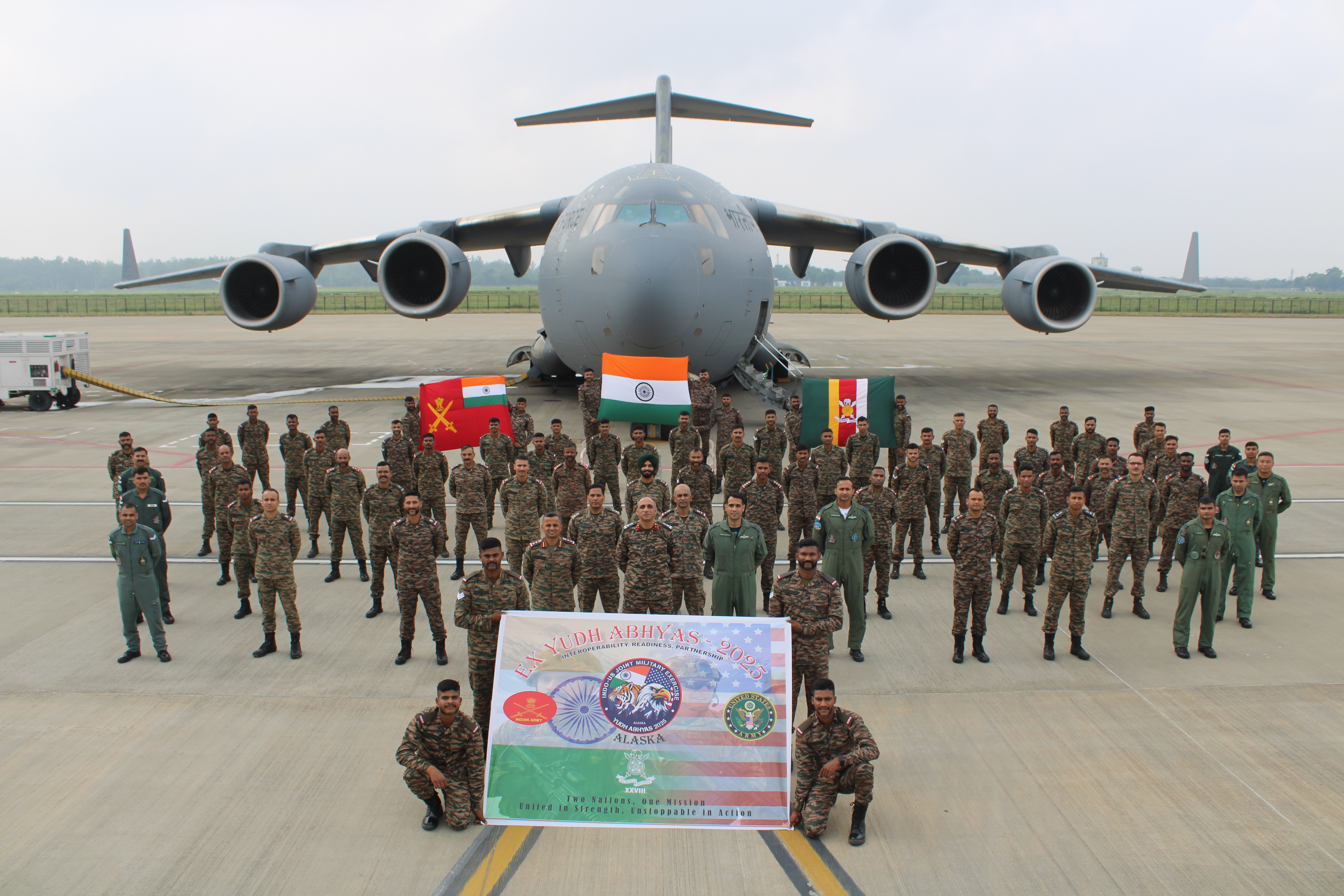
The 21st edition of the India–USA Joint Military Exercise, Yudh Abhyas 2025, is underway from September 1 to 14 at Fort Wainwright, Yukon Training Area, and Donnelly Training Area in Alaska. This annual bilateral exercise, alternating between India and the United States, aims to bolster interoperability, readiness, and cooperation between the two nations’ land forces.
This year’s Indian Army contingent includes personnel from the Madras Regiment and the 65th Infantry Brigade, training alongside the U.S. Army’s 1st Battalion, 5th Infantry Regiment “Bobcats,” part of the 1st Infantry Brigade Combat Team (Arctic), 11th Airborne Division.
Sponsored by the U.S. Army Pacific Command, the exercise features a brigade combat team command post exercise integrated with a bilateral field training program.
Over two weeks, troops will engage in a wide range of tactical drills such as heliborne operations, surveillance and unmanned aerial systems deployment, mountain warfare, casualty evacuation, and the coordinated use of artillery, aviation, and electronic warfare systems. Subject-matter experts from both armies will lead working groups on critical domains including UAS and Counter-UAS operations, information warfare, communications, and logistics.
The exercise also includes live-fire drills, high-altitude warfare scenarios, academic exchanges, cultural events, and professional development workshops. These activities are designed to enhance bilateral coordination, refine air-to-ground integration doctrine, and support United Nations peacekeeping capabilities.
Yudh Abhyas, which began in 2004 as a counterinsurgency training exchange, has evolved to address conventional, unconventional, and hybrid threats, as well as humanitarian assistance and disaster relief.
The exercise reflects the broader U.S.-India Major Defense Partnership and supports the U.S.-Indo-Pacific Command’s strategy to maintain a free and open Indo-Pacific. Leaders from both nations emphasized the shared commitment to addressing future global challenges through cooperation and mutual learning.
Last updated: December 26th, 2025

