
In a milestone for the planned Vadhvan Port project near Mumbai, Afcons Infrastructure, headquartered in Mumbai, secured the contract to construct a large offshore breakwater. The project is set to become India’s largest container port.
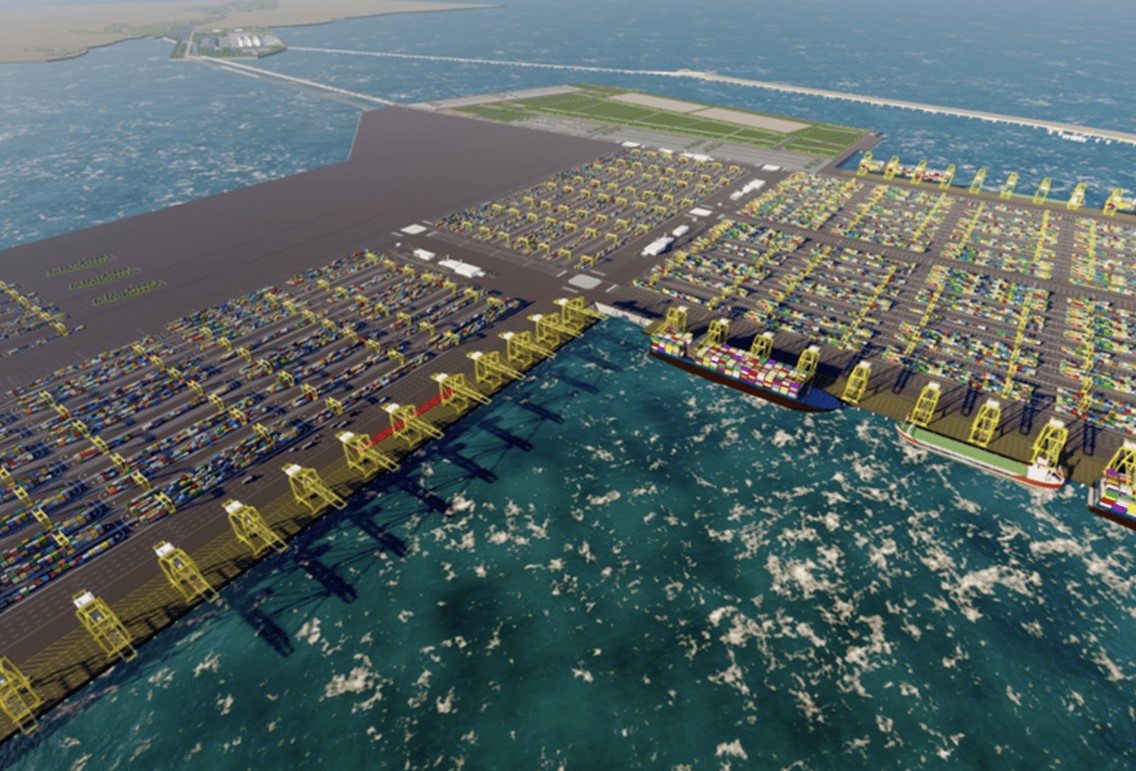
Vadhvan Port enjoys a strategic advantage due to its proximity to Mumbai, India’s financial and maritime hub. Located approximately 90 miles north of Mumbai, the Port is positioned to complement the existing port infrastructure of the region, including Jawaharlal Nehru Port Authority (JNPA) and Mumbai Port Authority.
Port officials highlighted that the Vadhvan site possesses a unique natural layout, allowing it to reach a projected shipping capacity of 339.5 million short tons per year by 2040. Furthermore, the site features a natural 59-foot draft, which completely eliminates the need for expensive initial dredging to deepen the shipping channels
The high-stakes bidding process drew proposals from four major international infrastructure consortiums. After technical evaluations, three finalists were shortlisted, with the port authorities opening the financial bids in the first week last week
The Winning Bid and Project Scale
The planned breakwater will stretch 6.3 miles into the Arabian Sea to shield the harbor from rough weather and ensure year-round operations. Afcons Infrastructure emerged as the lowest bidder with a quote of $623.6 million, narrowly beating out competitors such as the Adani Group’s ITD Cementation ($633.2 million) and Larsen & Toubro ($634.5 million).
The total cost to develop the entire all-weather, greenfield port is estimated at $8.96 billion. Once completed, it will serve as India’s 13th major port.
Capacity and Land Footprint
The Vadhvan Port is designed to handle 23.2 million TEUs (Twenty-foot Equivalent Units), the standard international measure for cargo capacity.
Total Land Identified: 1,418 acres, with roughly 50% classified as forest land and the remainder held by private owners.
Reclaimed Offshore Land: An additional 2,982 acres of land will be artificially created ihrough dredging and reclamation.
Port Layout and Public-Private Partnership
The mega-port will feature:
Nine container terminals, each measuring 0.62 miles (3,280 feet) long.
Four liquid cargo berths.
Four multipurpose berths.
One Roll-on/Roll-off (Ro-Ro) vehicle berth.
One Coast Guard berth.
In a first for an Indian port project, these facilities will be developed and operated under a Public-Private Partnership (PPP) model.
A separate $2.26 billion contract has already been floated for the dredging and land reclamation phase. This work will be split into two phases ($1.68 billion for Phase 1 and $580 million for Phase 2) under a 15-year agreement that includes 5 years for construction and 10 years for operations.

