
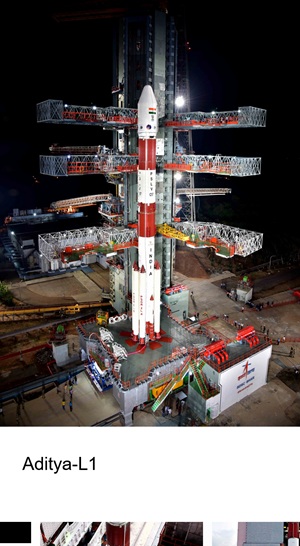
In 2024, India placed its first solar observatory, Aditya-L1, into orbit around the Sun at Earth Lagrange Point 1, or L1, about 930,000 miles from Earth. From this unique vantage point, the spacecraft enjoys an uninterrupted view of the Sun, free from eclipses or Earth’s shadow. It carries seven scientific instruments, the most important being the Visible Emission Line Coronagraph (Velc), which acts like an artificial moon, blocking the Sun’s blinding surface to reveal its faint corona.
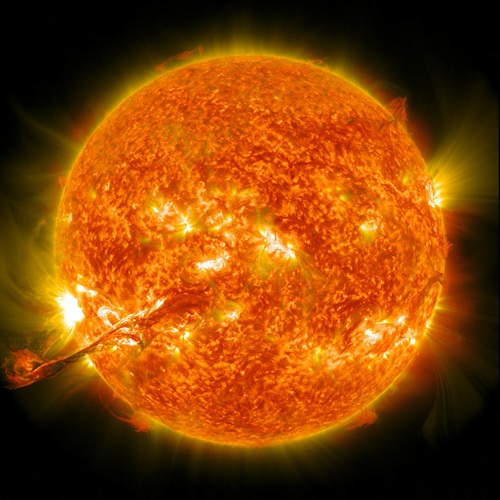
This mission arrives just in time. In 2026, the Sun will reach the peak of its 11-year activity cycle, when its magnetic poles flip and solar storms erupt with extraordinary force. Normally, the Sun produces two or three coronal mass ejections (CMEs) daily — massive bubbles of plasma that can weigh up to 1.1 trillion tons and race through space at 1,800 miles per second. At peak activity, scientists expect ten or more each day. These eruptions can cross the 93 million miles between the Sun and Earth in just 15 hours.
The risks are real. CMEs can trigger geomagnetic storms that disrupt satellites, knock out power grids, and scramble communications. History offers stark reminders: the Carrington Event of 1859 crippled telegraph lines worldwide; in 1989, Quebec’s grid collapsed, leaving six million people without power; and in 2022, a CME destroyed 38 commercial satellites worth hundreds of millions of dollars.
Aditya-L1 is designed to help humanity prepare. By measuring a CME’s temperature and energy in visible light, scientists can predict its strength and trajectory. Already, the mission has recorded a “medium-sized” CME in September 2024 with a mass of 297 million tons and energy equivalent to 2.2 million megatons of TNT.
For India, Aditya-L1 offers forewarning to protect satellites, power grids, and communication networks from the Sun’s fury. Data from Aditya will benefit the entire planet, not just the India.
Last updated: December 26th, 2025

