
While much of the American conversation about electric vehicles has centered on slowing domestic demand and shifting federal incentives, a Richmond, California company just demonstrated where the growth is going. Octillion Power Systems, a Tier 1 supplier of EV battery systems, has opened its third manufacturing plant in India — a roughly 140,000-square-foot facility in Halol, Gujarat in western India, that went from an empty shell to full production in under eight months. It is the company’s ninth plant worldwide.
The speed is worth pausing on. Eight months from empty building to operational battery manufacturing is aggressive by any standard, particularly for a product where thermal management failures carry real safety consequences. Company president Paul Beach framed the timeline as evidence that Octillion can move quickly without loosening the standards its automotive customers require.
The numbers
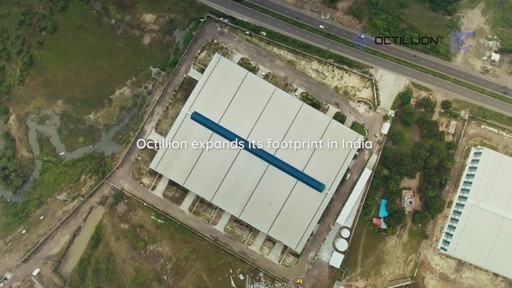
At full capacity, Halol will turn out more than 48,000 battery systems a year, representing over 3 gigawatt-hours of energy storage. Stacked on top of Octillion’s two existing Indian plants, the company expects to exceed 150,000 battery systems and roughly 9 GWh annually within the country. For scale, Octillion reported 24 GWh of total global production capacity in 2024 — meaning India alone will account for a substantial share of what the company builds anywhere.
Those packs are headed into passenger cars, buses, and commercial trucks, which is a meaningfully different mix from what a similar U.S. facility would serve.
Why India, and why now
The Indian EV market is expanding across nearly every vehicle category at once. Per JMK Research, EV sales there climbed 43% year over year in the first half of 2026, topping 1.54 million units and pushing overall EV penetration above 11%. Electric passenger cars grew 83%. Electric buses rose 42%, driven largely by government procurement programs — PM E-Bus Sewa and PM E-DRIVE — which allocated more than 4,200 buses in June 2026 alone, the strongest month for e-bus sales on record.
The most striking figure is in trucks. From a small base, electric commercial trucks posted cumulative growth exceeding 300% year over year as logistics and e-commerce fleets chase lower total cost of ownership — a curve American readers watching slow domestic Class 8 uptake may find instructive.
Behind the growth sit national targets that are more prescriptive than anything in U.S. policy: by 2030, India intends for EVs to represent 30% of private car sales, 40% of bus sales, 70% of commercial vehicle sales, and 80% of two- and three-wheeler sales.
The supply chain problem everyone shares
India’s constraint is one Americans should recognize. The country depends heavily on imported lithium, cobalt, and nickel, and research from the International Institute for Sustainable Development finds that domestic content for high-value components — cells, motors, controllers — remains under 20% for many manufacturers.
New Delhi is responding through a National Critical Minerals Mission funding domestic exploration and processing, the elimination of customs duties on 25 critical minerals, and a forthcoming policy aimed at building a complete local value chain for battery-grade materials.
Octillion’s pitch is that its Gujarat plant does more than final assembly. The company says it is embedding its standardized production process, thermal modeling work, and integrated battery management systems into local suppliers, shortening lead times and giving automakers in-country redundancy. Nikhil Parchure, an SVP at the company, argues that resilience requires depth — local sourcing, local quality control, local engineering — rather than square footage alone.
The takeaway
Octillion says it is currently the leading EV battery pack supplier in India across cars, buses, and trucks. Whether that position holds as global competitors expand is an open question. Amritt expect many international companies to enter the electric vehicle supply chain in India in the near future.

