
Artificial intelligence may be replacing some jobs, but at a startup in Bangalore, dogs are still very much part of the workforce.
Dognosis, an Indian healthcare startup, is combining the extraordinary sense of smell of trained dogs with sensors and artificial intelligence in an effort to develop a simple, noninvasive method of prescreening people for cancer. Patients don’t interact with the dogs. Instead, a person breathes normally into a cotton face mask for about 10 minutes. The mask is sealed and sent to a laboratory, where trained dogs smell the sample.
The underlying science is less far-fetched than it initially sounds.
Disease can alter the volatile organic compounds, or VoCs, produced by the human body. Dogs have an exceptionally sensitive olfactory system, with roughly 300 million scent receptors compared with about five million in humans. Researchers around the world have investigated whether trained dogs can distinguish biological samples from people with cancer and other diseases from those of healthy individuals.
Dognosis is attempting to make that biological ability more measurable and scalable. Its dogs wear customized equipment containing sensors that monitor their reactions as they examine samples. The company collects information including movement, respiration, brain activity and body language. Artificial intelligence is then used to analyze those signals rather than relying entirely on a human handler to decide whether a dog has detected something.
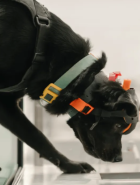
One of the company’s dogs, a Labrador mix named Chloe, has even attracted attention for the 3D-printed sensor-equipped helmet and harness she wears while working. Dognosis co-founder Akash Kulgod jokingly describes the equipment as a canine “Iron Man” suit.
Behind the novelty, however, is a serious attempt to address a major healthcare problem.
Early detection can substantially affect the treatment options available to cancer patients, while many cancers in India continue to be discovered relatively late. Dognosis is developing its BreathEasy system as a prescreening tool, not as a substitute for a medical diagnosis. Someone receiving a positive result would still require conventional clinical testing to determine whether cancer is actually present.
The company’s Phase 2 research has progressed beyond a small experimental study. The study is registered with the Indian government’s Clinical Trials Registry–India as CTRI/2024/10/075938 and was published in the Journal of Clinical Oncology this year. Researchers enrolled 3,275 participants across six hospitals in the state pf Karnataka, dividing them into 1,773 training participants and a separate 1,502-person test group. The test group included 283 treatment-naïve patients with biopsy-confirmed cancer and 1,219 controls.
Seven trained dogs were used to evaluate breath samples across seven major cancer groups. Dognosis reported sensitivity above 90%—the proportion of cancer cases correctly identified—and specificity above 91%, meaning the proportion of non-cancer samples correctly classified. Similar sensitivity was reported for early-stage cancers.
Those results are encouraging, but they should be interpreted cautiously. The Phase 2 research was a case-control diagnostic accuracy study rather than a demonstration of how the test would perform in routine population screening. Independent oncologists quoted in connection with the research have also emphasized that substantially larger studies are needed before conclusions can be drawn about its usefulness in everyday clinical practice.
Dognosis says it has now moved into a much larger Phase 3 study, launched in April and targeting approximately 10,000 participants across 10 hospitals. The larger study should provide considerably more information about how the approach performs in broader clinical use.
The company’s ambitions go considerably beyond a small laboratory full of talented dogs. Dognosis says that approximately 30 trained animals could eventually support as many as one million tests annually. It is targeting an at-home prescreening service in India in 2027 at a price of a few thousand rupees per test.
The startup has attracted venture capital backing from Accel India (which also funded Flipkart acquired by Walmart), which lists Dognosis in its investment portfolio and selected the company for its Atoms X program. Dognosis is also collaborating with medical institutions in India on its clinical research.

The dogs themselves work short shifts. Dognosis says they typically spend only 30 to 45 minutes a day working. Most are beagles, although the team also includes Malinois and shepherd mixes. They are trained through positive reinforcement, receiving treats when they correctly respond to targeted scents.
There is also an intriguing longer-term technology story behind the project.
Dognosis ultimately wants to understand canine olfaction well enough to reproduce some of the dogs’ capabilities using artificial sensors. In effect, the dog’s nose currently serves as an extraordinarily sophisticated biological sensor, while electronics and AI attempt to measure and standardize the response.
If the larger clinical studies confirm the early results, the immediate opportunity may not be to replace established cancer diagnostics. A low-cost breath-based test could instead provide an additional first layer of screening, identifying people who should undergo more definitive medical testing.
And if Dognosis eventually learns how to duplicate what its dogs can smell, even Chloe and her colleagues may someday face technological disruption. For now, however, their noses remain an essential part of the system.

