
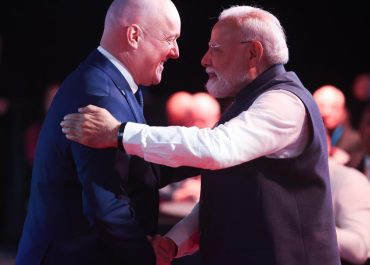
For only the second time in living memory, an Indian prime minister touched down in New Zealand. Narendra Modi‘s overnight stop in Auckland on July 10–11 was the first visit by an Indian head of government in four decades — the last was Rajiv Gandhi in 1986, who followed his mother Indira Gandhi’s trip back in 1968. New Zealand Prime Minister Christopher Luxon met Modi on the tarmac with a guard of honor and a hug, a bit of stagecraft that signaled just how Wellington wanted this one to go well.
For American readers watching the Indo-Pacific chessboard, the visit matters more than its brevity suggests. Two democracies on opposite ends of the Indian Ocean just agreed to knit their economies and their militaries closer together — and the timing, barely weeks after they closed a free trade agreement, was no accident.
A trade deal, then a partnership
The centerpiece is money. Modi and Luxon set a target of roughly doubling two-way trade to NZ$7 billion (about $4.2 billion) by 2030. Their new free trade agreement will eventually cut or scrap tariffs on 95 percent of New Zealand’s exports to India, with 57 percent going duty-free the moment the deal takes effect. For a farm-heavy economy like New Zealand’s — think dairy, meat, and wine — access to India’s 1.4 billion consumers is a genuine prize. India, in turn, gains a friendlier door into the Pacific. (The United States is eager to gets its chicken, eggs and dairy to India’s markets and I hope the New Zealand deal will spur some action on the US-India trade discussions)
On the strength of that deal, the two countries upgraded their relationship to a formal “Strategic Partnership” — diplomatic shorthand for we plan to do a lot more together. Modi called it a remarkable year for the two nations and said the next goal is simply to double that trade number.
Defense moves that will get Beijing’s attention
The part Washington will study in addition to trade is security. India and New Zealand unveiled a “Roadmap to 2030” heavy on maritime security, counter-terrorism, and cyber defense. They signed a mutual logistics arrangement letting the Indian Navy and the New Zealand Defense Force use each other’s bases for refueling, repairs, and resupply — the unglamorous plumbing that makes joint operations across a vast ocean far easier. They also launched an annual Maritime Security Dialogue and a joint working group on counter-terrorism for regular intelligence sharing.
None of this names China. But the subtext is hard to miss. Both countries want a stable, rules-based Indian and Pacific Ocean, and both have watched Beijing steadily expand its reach across the region.
Beyond the headlines
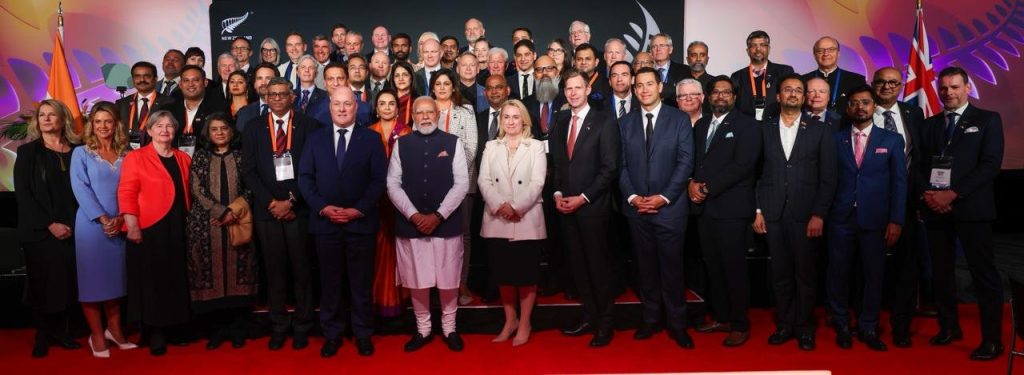
Not everything was warships and tariffs. Modi’s delegation came away with over a dozen separate outcomes, including agreements on disaster management, cultural exchange, and even a joint sports plan covering rugby, rowing, and golf. He closed the trip with a rally for New Zealand’s sizable Indian diaspora at Auckland’s Spark Arena — a reminder that people-to-people ties are the connective tissue holding all of this together.
Why it matters here
For the United States, a tighter India-New Zealand relationship is quietly good news. It reinforces the web of partnerships that keeps the Indo-Pacific in balance without America having to be everywhere at once. A confident India building its own network of friends — from Auckland to Tokyo — is the kind of cooperation U.S. policymakers have been encouraging for years.
Modi was on the ground for barely 24 hours. But the impact will last for decades.
Last updated: July 13th, 2026

