
On October 7, dignitaries gathered at the ITER facility to celebrate India’s vital contributions to the international fusion energy project. The event underscored India’s unwavering commitment to ITER, a multinational collaboration aimed at demonstrating the feasibility of fusion energy for peaceful purposes.
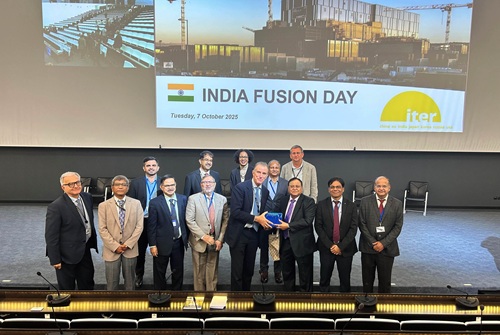
The ITER Organization is an intergovernmental organization that was created by an international agreement signed in 2006, and formally established on October 2007 after its ratification by all the ITER Members.
The purpose of the ITER Organization is to “provide for and promote cooperation among the Members on the ITER Project,” It acts as the overall integrator of the project and nuclear operator of the ITER facility.
Key Highlights:
India’s Leadership and Vision:
- The Indian delegation was led by V.K. Saraswat, a senior member of NITI Aayog and former head of India’s Defense Research and Development Organization.
- Saraswat emphasized nuclear energy’s role in India’s decarbonization strategy and projected that India’s energy demand will double by 2047.
- India aims to expand nuclear capacity from 9 GW to 100 GW by 2047, with fusion technology playing an important role.
ITER’s Global Collaboration:
- ITER was formally established in 2007 and includes members from China, Euratom, India, Japan, Korea, Russia, and the United States.
- The organization integrates efforts to build and operate the ITER fusion facility in France.
India’s Contributions to ITER:
- India’s involvement has accelerated domestic fusion capabilities, including staff training, supply chain development, and advanced technology creation.
- Indian companies such as Larsen & Toubro, INOXCVA, and Tata Consulting Engineers have enhanced their global competitiveness through ITER participation.
Technical and Strategic Impact:
- India played a key role in repairing ITER’s thermal shields, helping recover project delays and advancing machine assembly readiness.
- ITER Director, General Pietro Barabaschi praised India’s 20-year partnership and highlighted ITER’s role in nurturing global fusion expertise.
- He said, “… above and beyond India’s formal in-kind contributions to ITER, it has been critical in recuperating some of the delays of the past years by participating in the repair campaign for the thermal shields and “placing us in a very good position for the machine assembly activities ahead.”
India’s engagement in ITER reflects its long-term energy security strategy and its ambition to be a leader in fusion technology development. V.K. Saraswat told the assembly that “the perceived potential of fusion is recognized in the long-term energy security policy in India.”
Last updated: December 26th, 2025

