
American moviegoers who enjoyed Christopher Nolan’s The Odyssey this summer will soon encounter another ancient epic on an equally ambitious cinematic scale. Ramayana: Part One, produced by Namit Malhotra and directed by Nitesh Tiwari, is scheduled to open internationally on November 6, 2026, followed by India on November 8, the Diwali holiday. Sony Pictures is handling distribution outside India. The cast includes Ranbir Kapoor as Rama, Sai Pallavi as Sita and Yash as Ravana, with Sunny Deol as Hanuman. The film was made for IMAX, and a second installment is planned for 2027.
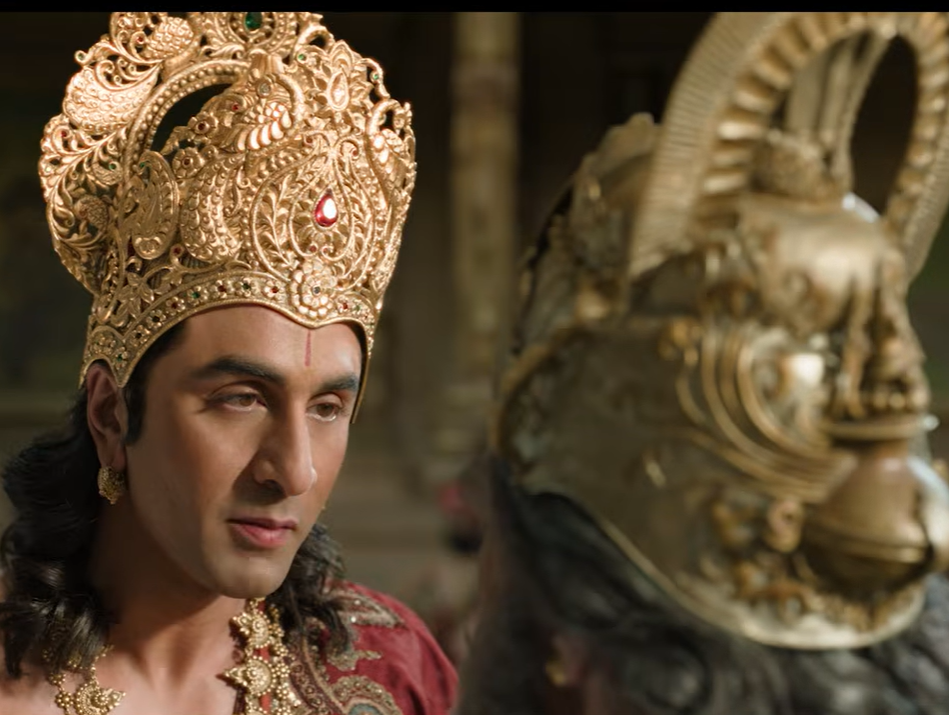
For Americans unfamiliar with the source material, the Ramayana is one of India’s two great Sanskrit epics and a foundational work of Hindu civilization. Traditionally attributed to the poet Valmiki, its 24,000 couplets tell the story of Prince Rama, his exile from his kingdom, the abduction of his wife Sita by the powerful king Ravana, and the campaign to rescue her. Yet calling the Ramayana simply “Indian” understates its reach. Over many centuries the story developed distinctive literary and performance traditions across Asia, including Thailand’s Ramakien, Cambodia’s Reamker, Indonesian and Balinese versions, Laos’s Phra Lak Phra Lam, Malaysia’s Hikayat Seri Rama and Myanmar’s Yama Zatdaw. Versions and retellings are also found in Nepal, Sri Lanka and beyond all the way to Japan.
The easiest Western comparison may be Homer’s Odyssey. Both are ancient epics built around royal heroes, long separations, supernatural intervention, warfare, loyalty and the restoration of rightful order. But their centers of gravity differ. The Odyssey is fundamentally the story of one man’s difficult journey home after the Trojan War. The Ramayana ranges more broadly across kingship, family obligation, exile, devotion and dharma—the moral and social duties that shape right conduct and is four times longer than the Odyssey. Odysseus is celebrated for ingenuity and adaptability; Rama is presented as an exemplar of principled conduct, even when duty carries an enormous personal cost.
For me, growing up in Uttar Pradesh, the Ramayana was part of everyday life. Its Hindi version, the “Ram Charit Manas” was recounted in neighborhood gatherings, my grandmother recited it to me and my little brother every day, even though she was only educated until the fourth grade. Its lessons are embedded deeply in my psyche even though I am not religious. As kids, every October, we would got o the fairground to watch the enactment of the battle for the conquest of Lanka, for ten days, culminating in a giant effigy of the ten-headed Ravana being burnt in a frenzy of fireworks. But we were also taught that Ravana was not all evil, he was actually a learned and wise man. Hindus in my native town often greet each other with “Rama, Rama” rather than “Namaste”.
The movie comparison is especially intriguing because Nolan’s The Odyssey and Malhotra’s Ramayana share an unexpected connection: DNEG. The visual-effects company was the sole VFX partner on The Odyssey and is a producer and VFX force behind Ramayana. Nolan’s film, released July 17, has already become a global phenomenon, passing $1.35 billion by yesterday
Ramayana now faces a different challenge: can an Indian story with enormous cultural familiarity in Asia become equally legible and compelling to audiences who may never have heard of Rama or Ravana?
Malhotra is well positioned to try. He founded Prime Focus and leads DNEG, one of Hollywood’s most accomplished visual-effects companies. DNEG teams have won eight Academy Awards for Best Visual Effects since 2011: Inception, Interstellar, Ex Machina, Blade Runner 2049, First Man, Tenet, Dune and Dune: Part Two. The company has also worked repeatedly with Nolan and other major filmmakers. In other words, Ramayana is not an Indian production trying to imitate Hollywood spectacle; much of the technical organization behind contemporary Hollywood spectacle is directly involved.
The production reinforces that global ambition. Oscar-winning composers A.R. Rahman and Hans Zimmer are collaborating on the score, while veteran Hollywood action specialists Terry Notary and Guy Norris are involved in action choreography. Reported production and marketing spending for the two films reaches roughly $500 million, putting the project in blockbuster territory.
For American audiences, Ramayana could therefore be more than a lavish foreign-language epic. If it succeeds, it may do for an Indian civilizational story what modern screen adaptations have repeatedly done for Greek mythology, Tolkien and comic-book universes: make unfamiliar names and worlds feel immediately accessible. Coming only months after The Odyssey, it also offers moviegoers a rare opportunity to see two of humanity’s most enduring epics translated into 21st-century large-format cinema—one from the Mediterranean world and one from India.
Last updated: August 25th, 2026

