JCB, the British construction-equipment maker headquartered in Rocester, Staffordshire, England, expects its arm in India, JCB India, headquartered in Ballabgarh, Haryana, near New Delhi in northern India, to grow at a double-digit rate this fiscal year even as the broader industry expands more slowly.
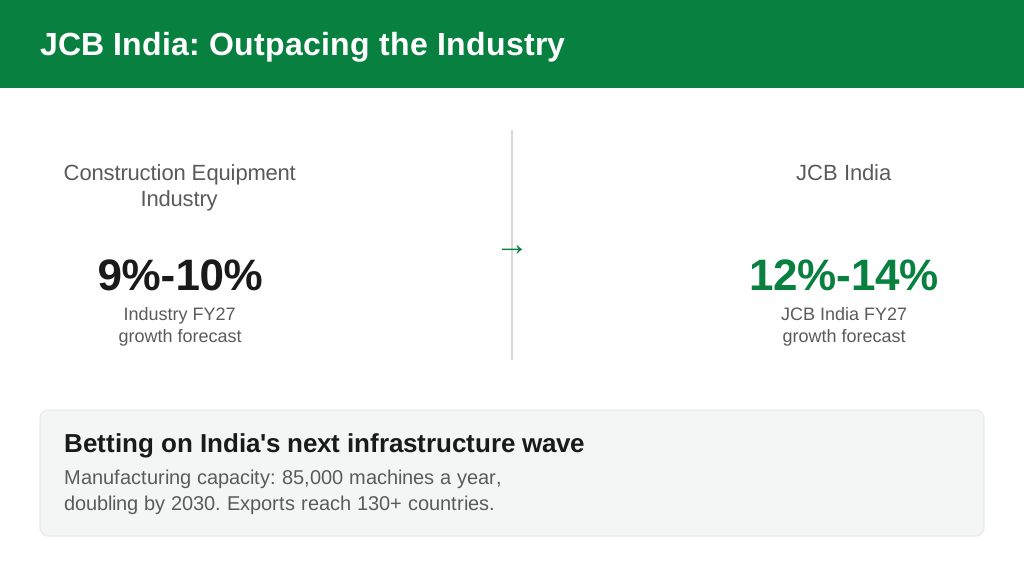
The construction-equipment industry should grow 9% to 10% in the fiscal year ending March 2027, while JCB India expects to grow faster, at 12% to 14%, Managing Director and Chief Executive Officer Deepak Shetty told Mint in an interview. India’s economy grew 8% in the quarter that ended in June, government data cited by Mint showed, reinforcing expectations that infrastructure spending will keep supporting growth. “The focus on infrastructure has only continued. That is very, very positive,” Shetty said. “The industry is growing. We are doing the right things and that is why those results are coming.”
Shetty said infrastructure spending should not be judged by roads alone. Railways, ports, rural connectivity and water projects have become important sources of demand for construction equipment. Railways, in particular, could become a significant new market for JCB. Building new track involves clearing and leveling land, strengthening soil, and moving and laying rails, all tasks where mechanized equipment can improve productivity. JCB works with India’s railway ministry to adapt its machines for that work. Rather than building entirely new equipment, the company engineers attachments and modifications that let its machines operate on both roads and railway tracks, and it develops technology for track maintenance, a need that has grown as train speeds have risen. “The focus the government has on infrastructure is going to yield dividends to this industry, not only in the short term but also in the long term,” Shetty said. Ports offer a further opening, as material-handling work increases use of JCB’s wheel loaders.
Exporting from India
The export side of the business points toward the United States. JCB’s operations in India supply machines and components to more than 130 countries, and the U.S. is its largest overseas market, according to the Mint interview. It ships not only machines but engines, transmissions and components from India to markets including the United Kingdom, the U.S. and Brazil, with its Vadodara plant, in western India, geared substantially toward exports. Industry-wide, construction-equipment exports from India rose 32% in the fiscal year that ended in March 2026, and Shetty — who also leads India’s construction-equipment manufacturers’ association — expects a further 30% increase this fiscal year, Business Standard reported. Tariffs the U.S. had raised on goods from India, to as high as 50%, have since eased to 15%, and Shetty said in the Business Standard interview that U.S.-bound shipments had started recovering as a result.
JCB has a manufacturing capacity of 85,000 machines a year in India, which it expects to double by 2030, supported by domestic and global demand. It has already localized 96% of its backhoe loaders, and 65% to 75% of its excavators, in India. The company raised prices by 3% to 4% across various months this year but absorbed most of the added cost through localization and efficiency gains rather than passing it fully to customers. “Construction equipment is where people earn their livelihood,” Shetty said. “We have to be very cautious that the person is able to earn that much rent versus the cost increase that we are giving.” Its newest backhoe loader adds an 8% improvement in fuel efficiency on top of a 14% gain introduced eighteen months earlier, and the company uses internet-connected sensors to monitor 300,000 machines for fuel use, machine health and operator performance.
JCB India invests $21 million to $53 million at current exchange rates — a year in research, development and capacity expansion in India, and introduces at least ten new products annually, Shetty said. He expects demand for construction equipment to potentially double over the next five years, giving JCB room to grow both its business in India and its role in the company’s global manufacturing network.
For American and European executives, the story is less about excavators than about where India is putting its money next. A government still spending heavily on infrastructure, now reaching into railways and ports rather than just roads, broadens the list of sectors where equipment, engineering and logistics providers can find work — and a foreign manufacturer’s willingness to bet on double-digit growth there is one more signal of how durable that spending looks.