
According to a number of media reports India’s Ministry of Defence issued a Request for Proposal (RFP) on August 12 for 60 new military transport aircraft, formally moving the Indian Air Force’s Multi-Role Transport Aircraft program out of study phase and into bidding. The contract is valued at $11 billion making it one of the largest defense competitions open anywhere right now. There are potentially five bidders. The RFP requires an Indian lead.
The aircraft will replace the IAF’s Soviet-designed Antonov An-32 fleet, which has been flying for decades, with an option for additional units beyond the initial 60.
Who’s competing
The requirement calls for an aircraft in the 18-to-30-tonne payload class, which puts two Western platforms at the center of the contest.
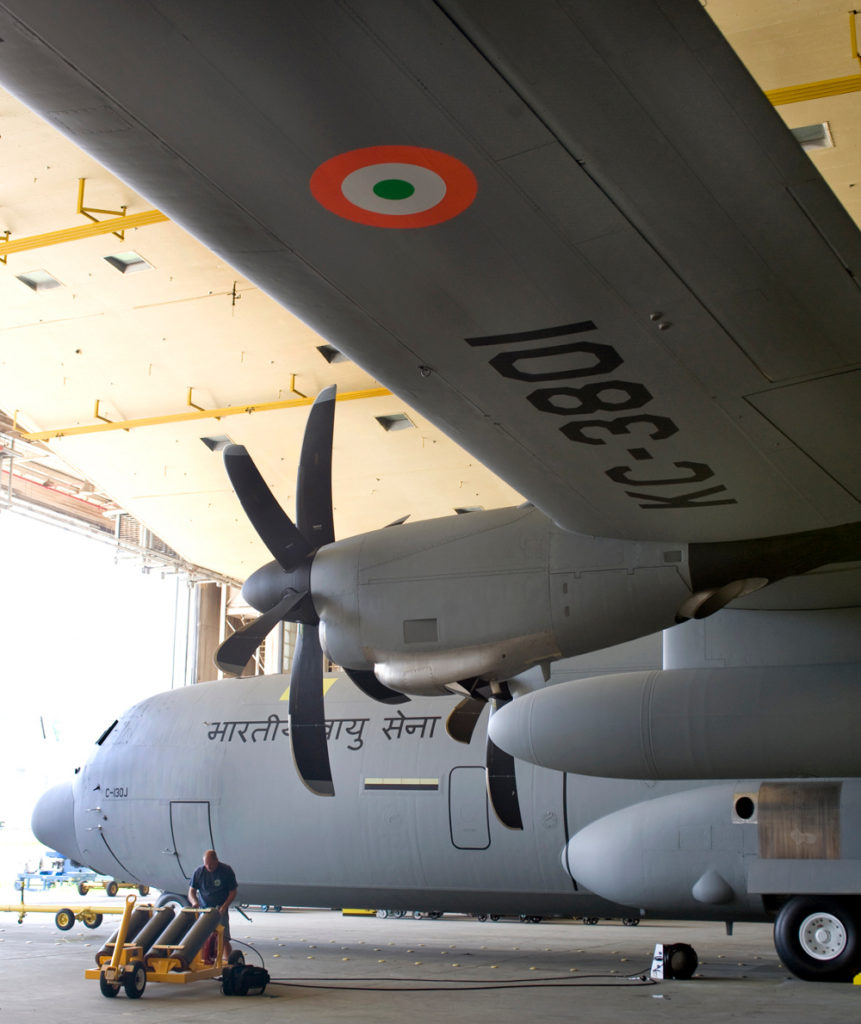
Lockheed Martin’s C-130J Super Hercules sits at the low end of that range, carrying about 19 tonnes. Its advantage is incumbency: the IAF already purchased 12 C-130J-30s it two phases (one crashed near Gwalior in 2014); Tata Lockheed Martin Aerostructures in Hyderabad is the global sole source for C-130J empennage assemblies. The two companies have also been standing up maintenance and overhaul capability in-country. Tata Advanced Systems is Lockheed’s partner on the bid.
Embraer’s C-390 Millennium is the newer and larger option, hauling up to 26 tonnes at a maximum cruise of Mach 0.80. More payload per aircraft means fewer sorties to move a given load — a real consideration for long-haul logistics. The Brazilian jet was also designed for semi-prepared runways. Mahindra Defence is Embraer’s Indian partner.
Airbus appears to be stepping aside. The A400M had been an expected entrant, but ThePrint reports the company is likely to sit the competition out because the aircraft’s 37-tonne payload overshoots India’s stated 18-to-30-tonne band. Earlier suggestions that cost was the disqualifier look secondary to the simpler problem of the plane being too big for the requirement.
The third team is state-owned Hindustan Aeronautics Ltd which may have revived a Multi-Role Transport Aircraft collaboration with Russia — an arrangement first struck in 2009 and abandoned in 2016. The RFP also went to Adani Defence and Aerospace and Reliance Defence, neither of which has publicly named a foreign partner. It is possible that one of these firms could edge out an existing alliance.
The industrial terms are the real contest
This is not a straightforward purchase. Roughly 20 percent of the fleet arrives in “fly-away” condition. Everything after that gets assembled or built in India.
Local content requirements are reported two ways: a minimum of 40 percent rising to 60 percent in phases. The winning OEM must stand up a final assembly line and MRO capability in India through a joint venture with its Indian partner.
On a flight back from India years ago, I sat next to a Lockheed pilot who said he had just demonstrated the ability for the Hercules to land and take off in the thin air near Leh, Ladakh, altitude about 12,000 feet. Operationally, the IAF wants aircraft that can work from high-altitude fields and unprepared strips, including the Advanced Landing Grounds in Ladakh and the Northeast. Aerial refueling configuration is a possible add-on.
The new fleet would slot between the C-130J’s specialized tactical role and the heavy lift provided by the Il-76 and Boeing C-17 Globemaster III the first 10 of which were not far from me, in Long Beach, California. India is already assembling Airbus C-295s domestically with Tata — roughly 70 aircraft planned — so the industrial model has precedent, just not at this scale.
Why It Matters
For American companies, this is a test of whether incumbency still wins in India. Lockheed has the installed base, the supply chain, and the existing joint venture. Embraer has the better spec sheet against the stated requirement. If a newer entrant takes a contract this size against an established U.S. supplier, it signals that India’s procurement calculus now weights industrial terms and capability fit over relationship history.
More broadly, the structure of this deal reflects where global defense procurement is heading. Buyers with scale are no longer purchasing aircraft — they are purchasing manufacturing capacity, and treating technology transfer as the price of market access. Any U.S. defense contractor selling into large emerging markets should expect these terms to become mainsteream rather than exceptional.
If your company is part of the supply chain for the aircraft mentioned above your prime may want you to get familiar with India. We can help you prepare. Talk to me https://calendly.com/gbagla/gb
A note on sourcing: as of this writing, none of this has appeared in an official government news release yet; we have seen this happen before for other acquisition news.

