
What do a Hindu festival, a Jewish festival, and doing business with India have in common? More than you might imagine.
Tomorrow, on Diwali, which always falls on a moonless night, my home will be lit up like Christmas!
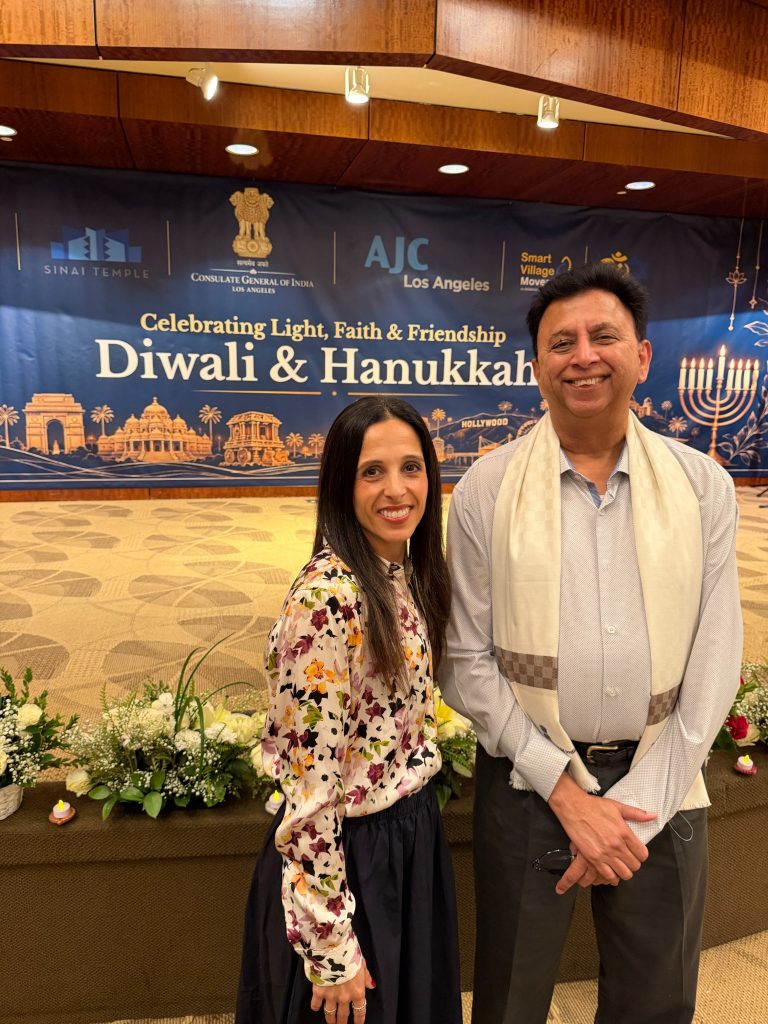
But last Sunday, my wife and I experienced something even more illuminating: a first-of-its-kind joint celebration of Diwali and Hanukkah at the magnificent Sinai Temple in West Los Angeles.
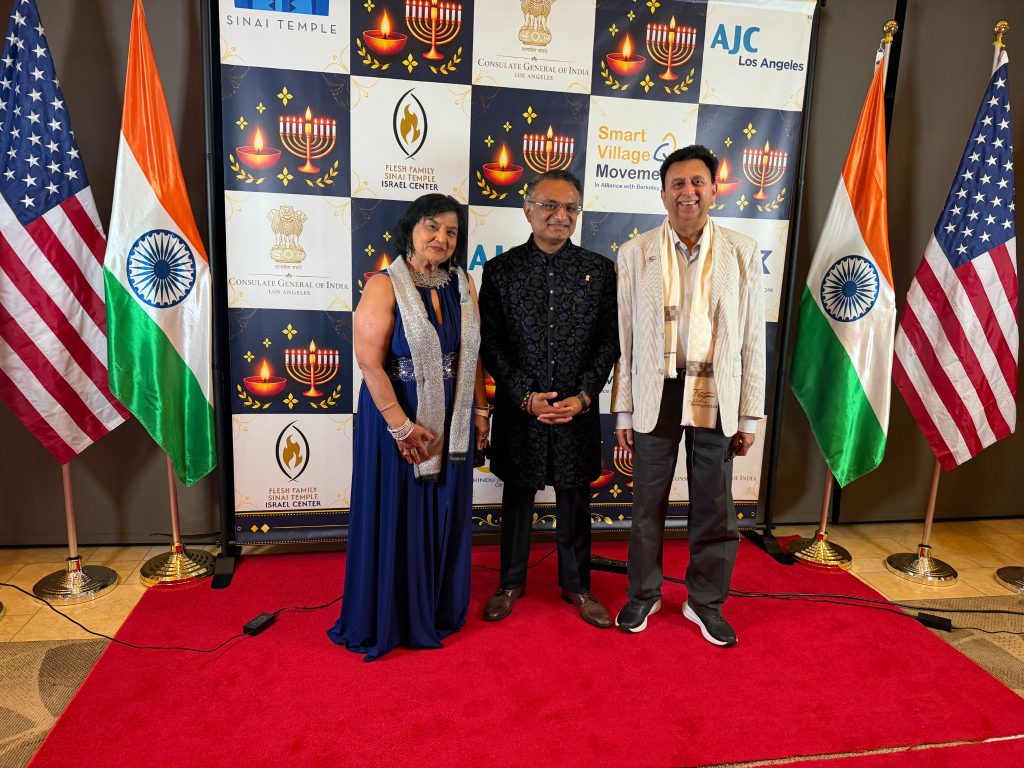
I was particularly gratified because the event grew from an idea I had planted several years ago. That spark eventually brought together Sinai Temple, the American Jewish Committee of Los Angeles, and the Consulate General of India for a memorable celebration of two ancient cultures.
Two faiths. Two festivals. One shared celebration of light.
Diwali, the Hindu Festival of Lights, celebrates the triumph of good over evil and light over darkness. Hindus illuminate their homes with oil lamps, exchange gifts, and share sweets. India’s Jains, Sikhs, and some Buddhist communities also observe festivals on the same day on the lunar calendar.
Hanukkah, the Jewish Festival of Lights, commemorates the rededication of the Second Temple in Jerusalem following the Maccabean revolt. For eight nights, Jewish families light candles on a nine-branched menorah, recalling the miracle of oil that lasted eight days.
Both celebrations speak to something universal: faith, resilience, hope, and the power of light to overcome darkness.
But the connection between India and Judaism runs much deeper than two festivals.
Jewish communities have lived in India for many centuries, with some traditions tracing their arrival back more than 2,000 years.
Three distinct communities took root: the Bene Israel of Maharashtra, the Cochin Jews of Kerala, and the Baghdadi Jews, many of whom settled in Mumbai and Kolkata.
Unlike the persecution that marked Jewish history in many parts of the world, Jewish communities in India have enjoyed religious freedom and peaceful coexistence with their Hindu, Muslim, and Christian neighbors.
They also left an impressive mark on Indian commerce, culture, early cinema, and the military. The prominent Sassoon family, for example, helped shape Bombay’s commercial infrastructure. The historic Sassoon Docks still operate in Mumbai today.
India’s tradition of religious hospitality extends beyond Judaism. According to ancient Christian tradition, the Apostle Thomas arrived in India in the first century CE, establishing a Christian presence in Kerala long before Christianity spread across much of Europe. Centuries later, Zoroastrians fleeing religious persecution in Persia found refuge in western India, where their descendants became known as Parsis.
So what does any of this have to do with business?
Quite a lot, actually.
Americans often approach India through the lenses of market size, economic growth, engineering talent, or manufacturing costs. Those are important considerations, but they tell only part of the story.
India is not simply a market of 1.4 billion people. It is a civilization shaped by thousands of years of cultural exchange, religious diversity, and coexistence.
Many Americans, including many American Jews, are unaware of the deep historical connections between India and Jewish communities.
Understanding such connections can help turn a business introduction into a meaningful conversation, a transaction into a partnership, and a partnership into a lasting relationship.
In my work helping American companies succeed in India, I have seen how much trust, personal relationships, and cultural sensitivity matter. Technical competence and a compelling business proposition may get you into the room. Cultural understanding can help you build the relationships that keep you there.
That is why last Sunday’s celebration was more than an enjoyable evening of interfaith friendship. It was a reminder that some of the strongest bridges between countries are built not by governments or corporations, but by people who take the time to understand one another.
Sometimes, building a bridge between cultures begins with something as simple as lighting a lamp.

