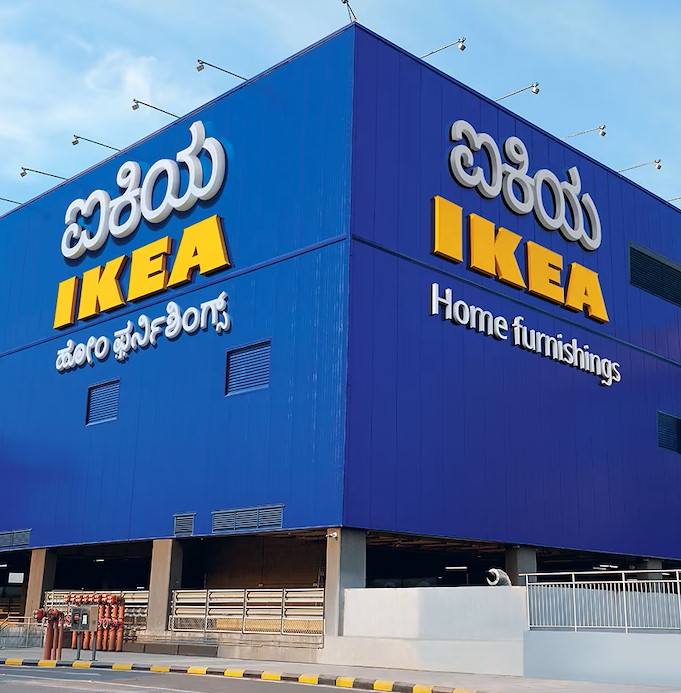
IKEA, the Sweden-headquartered home furnishings retailer, wants to quadruple its revenue in India by 2030. The Economic Times reported that the company plans to grow from eight stores to thirty and to double its investment in the country to $2.2 billion at current exchange rates. IKEA is recording double-digit sales growth in India, and Patrik Antoni, chief executive officer of IKEA India, expects the business to turn profitable in the fiscal year ending March 2028 if global conditions stabilize.
A few months ago, I visited the first IKEA store in India in the city of Hyderabad. The multistorey warehouse felt similar to the company stores in California except that they offer assembly of products. The company is also sourcing much of its products from within India; signage emphasizes its Swedish heritage throughout the store.
The path to thirty stores runs through smaller formats. Antoni told Business Standard that smaller stores bring IKEA closer to shoppers. The company has so far leaned on large stores in Hyderabad, in southern India, Navi Mumbai, in western India, and Bengaluru, in southern India. According to media reports, only a quarter of the new network will be large stores. The rest will be mid-size stores of roughly 70,000 square feet and small stores of roughly 25,000 square feet, with more mid-size stores planned for Delhi, in northern India. The retail workforce is also set to double to 5,000 people by 2030.
A different customer
Antoni, who worked in India as deputy chief executive from 2013 to 2018, says furniture buying in households in India is a family decision. Spouses, children and grandparents often weigh in, and men take an active part in choosing items from bookshelves to dining tables. He said IKEA must adapt its products and displays to how families in India live rather than replicate designs from other markets. He also points to a generation of young shoppers, which he put at 400 million, who grew up with more exposure to global brands.
Pricing is the open question. Prices were cut in Europe, according to the report, and Antoni said IKEA will watch the situation before it adjusts prices in India. On The Core podcast he said the company has not raised its price level in India. According to media reports, IKEA also wants locally sourced products to rise from 30% of sales to 50%.
What it means for American companies
IKEA opened its first India store in Hyderabad in 2018 and still expects to wait until fiscal year ending March 2028 for a profit. That timeline is worth noting for any US company that expects quick returns from a retail launch in India. The retailer is paying for scale first: more stores in six cities, a larger local supply base and formats built for smaller spaces. American retailers, furniture makers and suppliers should read the plan as a signal that a European brand with deep pockets sees a large home market there, and that its sourcing push will draw on local manufacturers.