
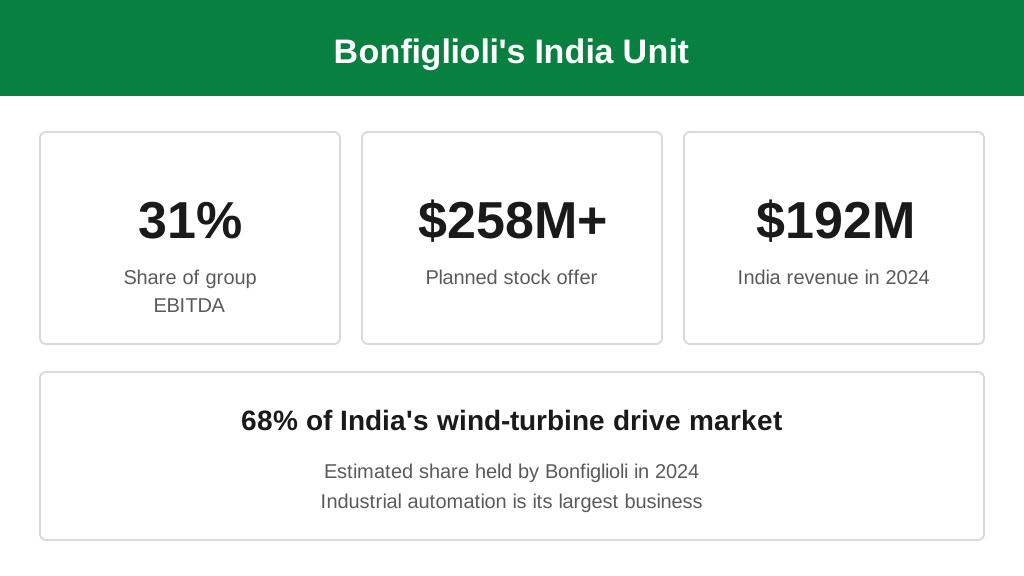
Bonfiglioli, the Italian maker of gearboxes and drive systems, plans to list its India subsidiary on the stock market, BusinessLine reported on Friday. The offer would be worth $258 million, and it would be a sale of shares by the parent company.
The parent, which has its headquarters in Calderara di Reno, in Italy’s Bologna province, and 5,000 employees, would receive the proceeds.
Managing director Kennady V Kaippally told BusinessLine why the company is going public now. “We have reached a maturity where we can stand on our own,” he said. He added that investors should look at the company’s competitive position, financial strength and growth prospects, not just the structure of the offer.
What the company makes. Bonfiglioli supplies gearboxes and drives for wind turbines, excavators, cranes, road-building machinery and industrial equipment. BusinessLine reported that it held 68% of the wind-turbine drive market in India in 2024. Industrial automation is its largest business, at approximately 40% of revenue, and the company serves more than twenty manufacturing sectors. Exports account for approximately 28% of sales. “China-plus-one is a real story for Bonfiglioli now,” Kaippally said, pointing to companies moving supply chains away from China.
The company has invested ₹680 crore ($70 million at current exchange rates) in India over twenty-five years, according to BusinessLine. Its plants are in Chennai, in southern India, and Pune, in western India. It spent ₹100 crore ($10 million at current exchange rates) on a smart manufacturing plant at Talegaon, near Pune, and plans a separate heavy-duty gearbox plant nearby. Heavy-duty drives bring in 4% of revenue today. The Italian parent keeps ownership of the main technology and trademarks, which it licenses to the India company for royalties.
BusinessLine said the four markets Bonfiglioli serves in India are projected to grow from ₹10,897 crore ($1.1 billion at current exchange rates) in the fiscal year ending March 2027 to ₹14,280 crore ($1.5 billion at current exchange rates) by the fiscal year ending March 2030.

