Nothing, the London-based consumer electronics company known for its smartphones and earphones, is spinning off its budget sub-brand CMF into a standalone company headquartered in India and majority owned by shareholders from India. Co-founder and chief executive Carl Pei announced the move in a post on X, reported by Business Standard
Pei wrote that CMF “stops being a product line inside a London company and becomes a company of its own, incorporated in India, controlled in India, majority owned by Indian shareholders.” Nothing will keep a stake in the new company and remain a partner, contributing its engineering work, operating system, supplier relationships and experience building a global brand. India, in turn, contributes its manufacturing base, talent pool and domestic market. “Being a partner means the company is Indian: owned in India, run from India, engineered in India,” Pei wrote.
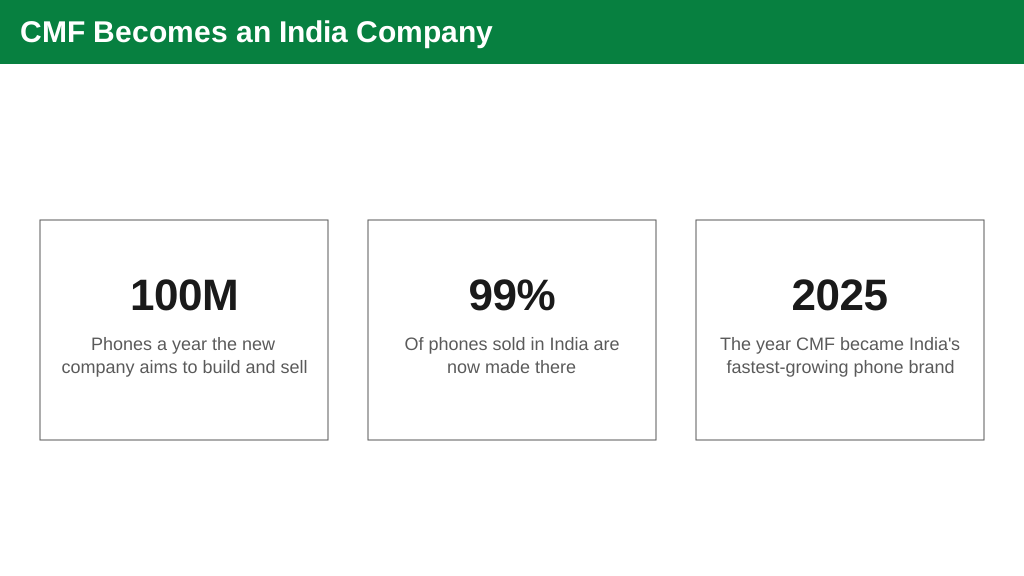
CMF launched as Nothing’s more affordable consumer-technology line and became the fastest-growing smartphone sub-brand in India in 2025, according to Pei. The new, independent company’s goal is to design and sell 100 million phones a year, a scale Pei said would let it shape its own electronics supply chain rather than simply buy from it: “A 100 million a year is the line between a brand and a platform. Below it, you’re a customer of the supply chain. Above it, you’re the reason it exists.”
The move follows India becoming, in Pei’s framing, the world’s second-largest smartphone manufacturing hub. Citing government and industry data, Pei said 99% of smartphones sold in India are now made domestically, compared with almost none a decade ago. He has argued separately that manufacturing capacity alone is not enough: India’s next step, in remarks carried by The Economic Times, is building the research and development work that turns a manufacturing base into homegrown global brands, following the path he says Japan, Korea and China each took before it. “Manufacturing is step one,” Pei said. “Step two is R&D.”
Why this matters
Most foreign companies talk about India as a market to sell into or a factory to build in. Nothing is doing something rarer: handing a piece of itself over, ownership and headquarters included, and betting that a company majority owned from India can still carry its engineering work forward and go on to compete globally. For American and European executives watching India’s electronics buildout, the CMF spin-off is a test of whether “made in India” can become “owned and engineered in India” without the parent company losing its investment.