
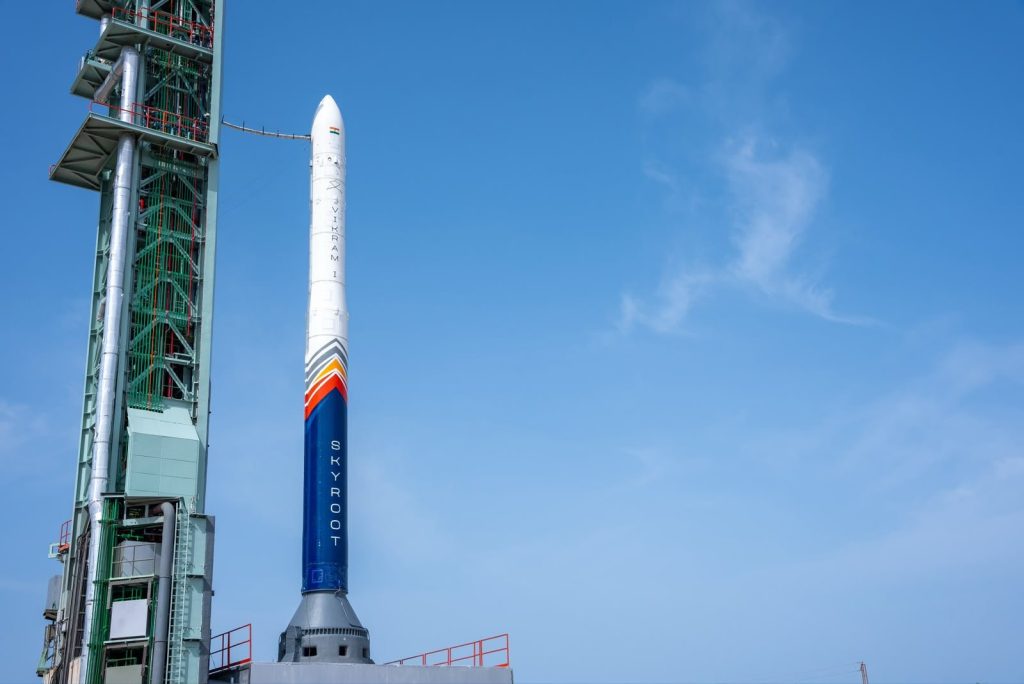
A rocket built by an eight-year-old startup climbed off a launch pad on India’s east coast this weekend and settled into orbit, and in the process it rewrote a small piece of spaceflight history. With the flight of its Vikram-1 rocket, Hyderabad-based Skyroot Aerospace became the first private Indian company to reach orbit from Indian soil—and vaulted India into a very short list of countries where a commercial firm, not a government agency, can do the job.
Only the United States and China had gotten there before. India makes three.
What happened on the pad
Vikram-1 lifted off from the Satish Dhawan Space Center at Sriharikota, the barrier-island spaceport in the Bay of Bengal that has launched India’s biggest missions for decades. The countdown didn’t go entirely to script: a last-minute technical snag forced a hold of roughly 35 minutes, pushing the departure from its planned late-morning slot to 12:05 p.m. local time (that’s 1:35 a.m. Eastern).
From there, the flight was clean. Three solid-fuel motors fired in sequence to punch the rocket up through the atmosphere, and a small liquid-fueled fourth stage took over to accelerate the payloads to orbital speed—somewhere around 17,000 mph. About 15 minutes after leaving the pad, Vikram-1 had reached an orbit roughly 280 miles (450 kilometers) up. Mission control called the flight complete at the 17-minute mark. Indian officials described it, without much restraint, as a grand success. The company named the mission Aagaman, Sanskrit for “arrival.”
A modest rocket, built the hard way
Vikram-1 won’t be confused with the heavy-lift behemoths that carry crews and deep-space probes. It stands about 72 feet tall and can haul up to about 770 pounds (350 kilograms) to low-Earth orbit. That’s small, but it’s a deliberate kind of small. It also makes Vikram-1 a bit bigger than Rocket Lab’s Electron, the American-built vehicle that has become the workhorse of the dedicated small-satellite business.
What sets the rocket apart is how it’s made. Skyroot leaned hard into modern manufacturing: an all-carbon-composite airframe and a 3D-printed liquid engine, on a platform the company describes as almost entirely homegrown. Co-founder and CEO Pawan Kumar Chandana has pitched the roughly 350-kilogram class as the sweet spot for small satellites—heavy enough to be worth a customer’s money, light enough that Skyroot can fill the rocket and fly it often.
He’s also been careful not to oversell this one. Skyroot is framing the flight as a test, a data-gathering run meant to prove the vehicle works before a short series of follow-on launches establishes it as commercially ready. In other words, the champagne is justified, but the business hasn’t started yet.
What it carried
The payload manifest was a mix of the practical and the sentimental. On the working side: a nanosatellite from Grahaa Space, Skyroot’s own SCOPE satellite, a soft-robotic debris-capture experiment from Cosmoserve Space, and a technology demonstrator from the German firm DCUBED.
There was symbolic cargo, too—an artwork made with a lab-grown diamond, plus microscopic 18-karat-gold sculptures honoring three giants of Indian science: Vikram Sarabhai (the rocket’s namesake), Nobel Prize winning physicist C.V. Raman, and former President and aerospace scientist A.P.J. Abdul Kalam. Skyroot said the sculptures were smaller than a grain of rice.
One detail worth getting right: not everything aboard flew off on its own. SCOPE and the Grahaa satellite were released into orbit as free-flying spacecraft, while the rest of the experiments stayed attached to the rocket’s upper stage to run their tests there.
Private company, public runway
For all the “private first” headlines, this wasn’t a solo act. The rocket was Skyroot’s, but much of of the support was provided by the Government. India’s space agency, ISRO, supplied motor-casting and test facilities, liquid-engine testing, trajectory analysis, safety support, vehicle integration—and the launch pad itself. A newer government body, IN-SPACe, handled the access and authorization that let a startup use national infrastructure at all.
That partnership is the real story underneath the milestone. India only opened its space sector to private players in 2020. Six years later, one of those players is in orbit.
From a Hyderabad office to space
Skyroot’s arc has been quick. Chandana and co-founder Naga Bharath Daka, both ISRO veterans, started the company in 2018. Today it says it employs more than 1,000 people across propulsion, avionics, manufacturing, and launch operations, and in June it became India’s first space-tech “unicorn,” valued north of a billion dollars.
The company’s first flight humbler—a single-stage suborbital rocket called Vikram-S that reached about 55 miles up in November 2022. Getting to orbit is a different order of difficulty entirely.
The bottom line
For investors, the calculus just shifted from “can they build a rocket that works?” to “can they do it again, on schedule, for paying customers?” That’s a better problem to have. If Skyroot’s follow-on flights hold up, India won’t just have a private path to orbit—it’ll have a company ready to sell rides on it.

