
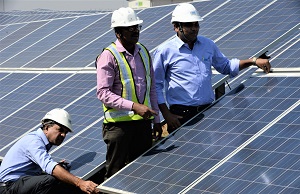
India is rapidly transforming its energy landscape, positioning itself to become the first major economy to industrialize primarily through solar power rather than coal. Leading this charge is the Khavda Solar Park in the Rann of Kutch. By 2029, this 280-square-mile facility will host 60 million panels, generating 30 gigawatts—enough to power the entire nation of Austria and 30 times the output of a standard nuclear plant.
The turbines are each about 200m tall. Each blade, 78m long, is transported on specialized trailers that move at dawn, before heat and wind make construction unsafe. The site will eventually feature nearly 60 million solar panels, many mounted on trackers that tilt through the day to maximize sunlight. At night, wind speeds rise, allowing turbines to take over as solar generation drops.
Key Drivers of the Transition
Rapid Growth: India’s solar capacity is expanding by 40% annually. It surpassed 150 GW in early 2024 and is projected to double by 2030.
Economic Shift: Unlike the West or China, which relied on coal for growth, India is leveraging plummeting solar and battery costs to “leapfrog” the carbon-heavy industrial phase.
Sector Wins: Beyond the grid, India has electrified nearly its entire 42,000-mile rail network, and 60% of new motorized rickshaw sales are now electric.
Infrastructure & Storage Hurdles
While the shift is aggressive, India faces significant “growing pains” in balancing its legacy systems with new technology:
| Challenge | Current Status | Proposed Solutions |
| Grid Bottlenecks | Solar plants take ~2 years to build; transmission lines take ~5. Last year, 40% of solar output failed to reach consumers. | A $100 billion investment to expand the national grid by 29% via “green energy corridors” by 2032. |
| Nighttime Supply | Solar currently provides 28% of capacity but only ~9% of actual supply due to storage limits. | Deployment of pumped hydro storage (water batteries) at 120 potential sites and mandate for new solar farms to include Li-ion batteries. |
| Supply Chain | High reliance on China for PV cells and lithium-ion battery components. | Federal incentives to boost domestic manufacturing and reduce import dependency. |
The Coal Context
Despite the solar boom, coal still provides 70% of India’s power. However, the tide is turning:
Coal’s share of the energy mix is expected to drop below 50% by 2035.
Environmental & Social Impact
The transition isn’t without friction. The massive land requirements for solar farms have raised concerns about wildlife corridors in the Rann of Kutch. To mitigate this, some developers are experimenting with agrivoltaics (farming beneath panels) and utilizing autonomous robots to clean panels with air rather than scarce desert water.
Why It Matters Globally
India’s per capita electricity use is currently only 10% of the U.S. average. If India successfully scales its economy using solar as its backbone, it provides a blueprint for other emerging nations to develop without the catastrophic climate impact of traditional fossil fuel industrialization.
What aspect of India’s renewable energy scale-up interests you most—the technological storage solutions or the geopolitical shift away from coal?

