
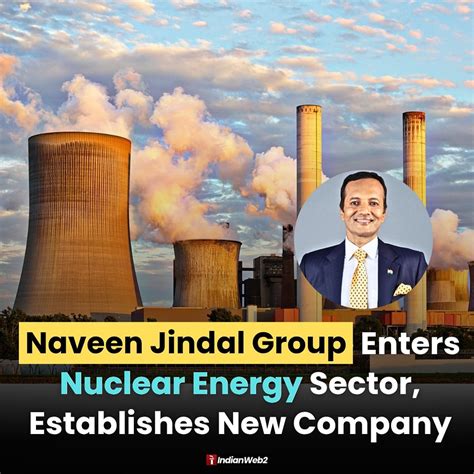
The Naveen Jindal Group announced the creation of Jindal Nuclear Power Private Limited, a wholly owned subsidiary of Jindal Renewables. The new company will focus on building, owning, and operating nuclear power plants in India. Over the next 20 years, Jindal Nuclear aims to contribute 18 gigawatts (GW) of capacity toward India’s national target of 100 GW of nuclear power by 2047.
Supporting India’s Low-Carbon Energy Goals
The initiative aligns with the Government of India’s 2025 Federal Budget, which set a goal of 100 GW of nuclear capacity by 2047. According to the company, nuclear power will play a key role in supporting sustainable economic growth, reducing carbon emissions, and providing reliable, round-the-clock energy. Jindal Nuclear is one of the first private sector companies in India to formally express interest in nuclear power investment, marking a significant step in India’s transition to a low-carbon economy.
The company hopes to use a mix of advanced technologies, including Bharat Small Reactors (BSRs), Small Modular Reactors (SMRs), and Generation IV reactors, as they become commercially viable. These technologies are expected to enhance safety, efficiency, and environmental sustainability.
Private Sector Entry into Nuclear Energy
India’s nuclear energy sector has historically been closed to private investment. Recently, the state-owned Nuclear Power Corporation of India Ltd (NPCIL) issued a public notice inviting private sector participation in setting up BSRs, which are reactors with capacities up to 220 megawatts (MW). In her Federal Budget speech, Finance Minister Nirmala Sitharaman announced that private companies would now be allowed to enter the nuclear energy space.
S. K. Sharma, Senior Advisor at Jindal Nuclear and former Chairman of Nuclear Power Corporation of India Limited (NPCIL), stated that the company’s 18 GW development plan reflects its commitment to supporting India’s vision of CO2-free energy. He emphasized that private sector involvement will be essential to achieving the government’s long-term nuclear energy goals.

