
The U.S. and India have partnered to make a one of a kind satellite that can image the Earth. It cost over $1billion to make and is slated to be the most expensive earth imaging satellite ever to be made in the world.
Called the NASA-ISRO Synthetic Aperture Radar Satellite or NISAR, it is a joint Earth-observing mission between NASA and the Indian Space Research Organization (ISRO) with the goal to measure Earth’s changing ecosystems, dynamic surfaces, and ice masses, providing information about biomass, natural hazards, sea level rise, and groundwater, and will support a host of other applications. It will help American and Indian scientists to gain a better comprehension of the speed and impact of climate change. It will also collect data aimed at helping people across the world manage natural resources and hazards better.
NISAR will be the first radar of its kind in space to systematically map Earth, using two different radar frequencies (L-band and S-band) to measure changes in our planet’s surface less than a centimeter across. Synthetic aperture radar (SAR) refers to a technique for producing fine-resolution images from a resolution-limited radar system.
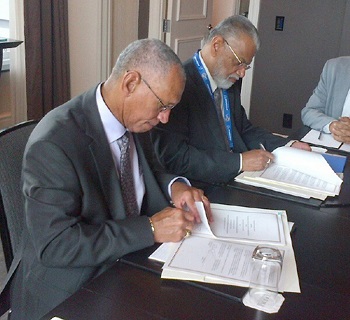
NASA Administrator Charles Bolden (left) and ISRO Chairman K. Radhakrishnan signing documents in Toronto on Sept. 30, 2014, to launch a joint Earth-observing satellite mission and establish a pathway for future joint missions to explore Mars. Credit: NASA
On Sept. 30, 2014, NASA and ISRO signed a partnership to collaborate on and launch NISAR. The mission is targeted to launch in 2024. NASA is providing the mission’s L-band synthetic aperture radar, a high-rate communication subsystem for science data, GPS receivers, a solid-state recorder and payload data subsystem. ISRO is providing the spacecraft bus, the S-band radar, the launch vehicle and associated launch services.
Paul A Rosen, Project Scientist, NISAR satellite, Jet Propulsion Laboratory, NASA, Pasadena, Los Angeles said that NISAR is the first big collaboration between NASA and ISRO.
Last updated: December 26th, 2025

