
For decades, large multinationals built teams overseas to handle software development, global engineering, technology scouting, finance, and back-office operations. These “captive centers” were designed to save money and add capacity — efficient, but often isolated.
Today, those captives have evolved into Global Capability Centers (GCCs): strategic engines that drive innovation, own and shape products, and create competitive advantage. And strikingly, you no longer need to be a Fortune 500 company to build one. Small and mid-sized businesses across industries are discovering that a GCC is not only about cost, but also capability, speed, and resilience.
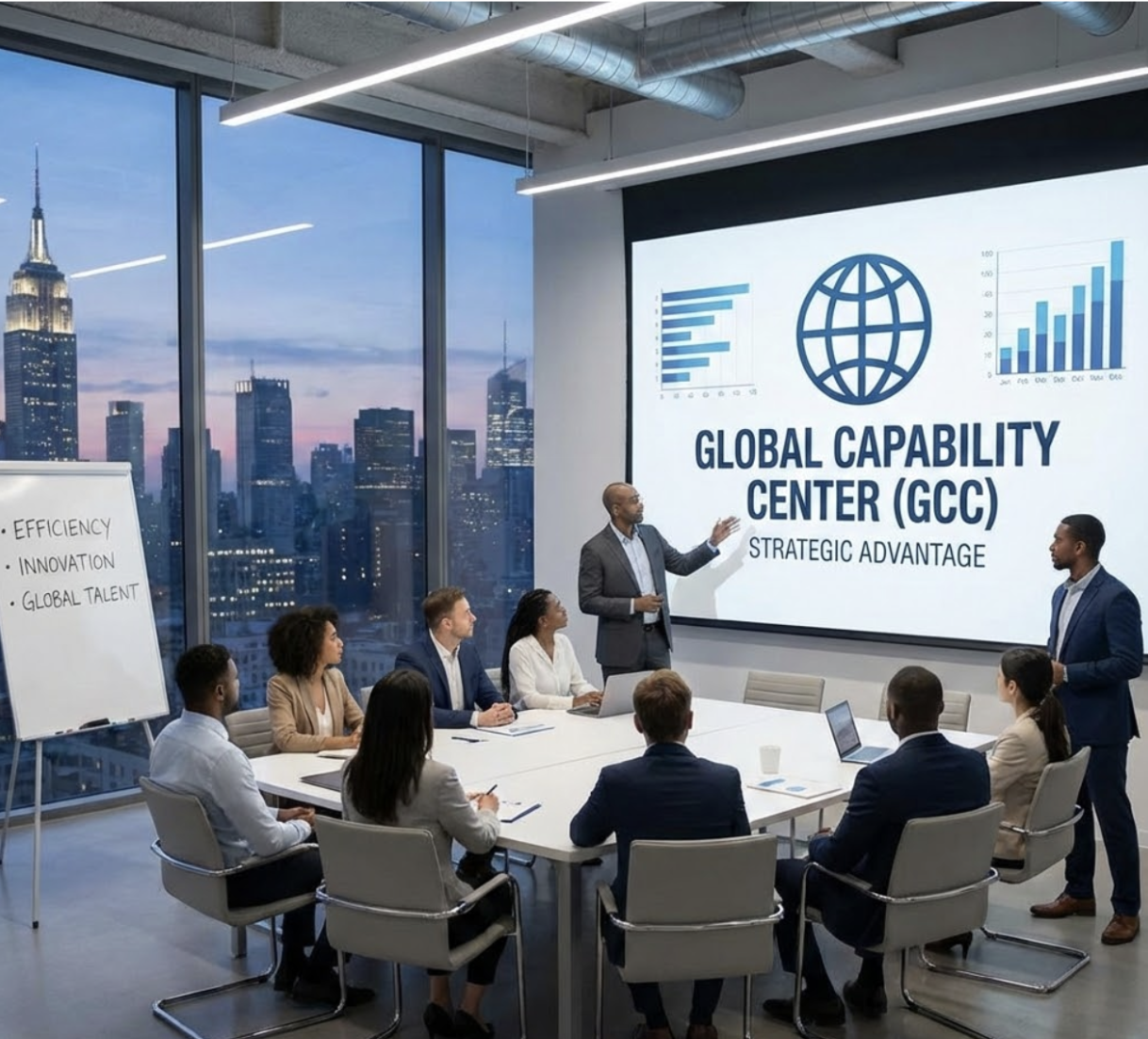
What Exactly Is a GCC?
A Global Capability Center is a wholly-owned extension of a company, located in another country, that performs key business or technical functions for the parent organization.
In the old model, GCCs were
mostly about “offshoring”; teams In India and other countries handled support or QA while strategy stayed at headquarters.
Today, that model is outdated. Modern GCCs:
- Build and own products used globally
- Lead AI and data science initiatives
- Support business units directly
- Serve as global talent and innovation hubs
In short, a GCC today is a frontline capability center. Decisions about GCC charter and ownership are now made at the highest levels, unlike earlier eras when product ownership was difficult to secure for offshore teams.
Why a GCC Is Not Outsourcing
Outsourcing delegates work to a vendor. A GCC is different. It’s your own team, operating under your brand, culture, and intellectual property.
You retain full control of priorities, quality, and knowledge – making the GCC a true extension of your organization, not a third-party provider.
Why Companies Are Building GCCs Globally
GCCs have become central to how companies rethink where and how work gets done.
Here’s why they’re worth serious consideration:
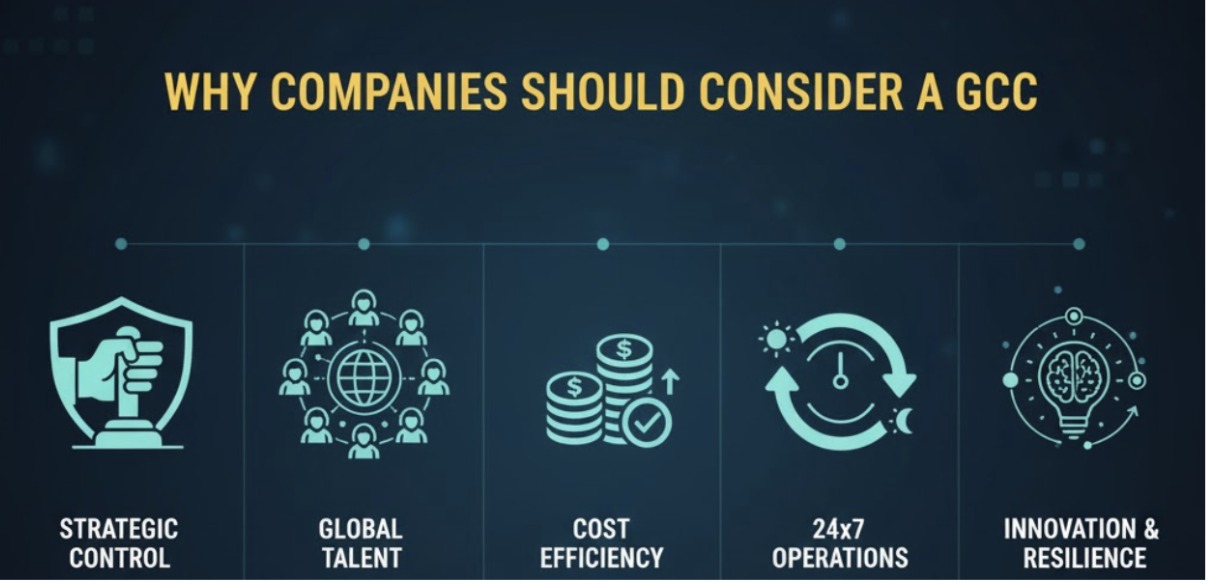
1. Strategic Control and Ownership
A GCC keeps your most important processes, data, and intellectual property in-house. Unlike outsourced models, it builds institutional knowledge and a shared culture aligned with company values, creating long-term strategic advantage.
2. Access to Global Talent
Enterprises now draw from world-class talent pools across Eastern Europe, Asia-Pacific, and Latin America.
These hubs bring deep expertise in software engineering, AI, product design, and data science, enabling true follow-the-sun collaboration where innovation continues around the clock.
Many GCCs now manage teams not just locally but also across multiple geographies, including headquarters.
3. Strategic Cost Efficiency
Cost remains a factor, but forward-thinking companies treat it as fuel for reinvestment, not just savings.
Efficiencies from a GCC are often redirected into faster product cycles, deeper R&D, or global expansion, turning financial advantage into strategic leverage.
4. 24×7 Execution
With teams distributed across continents, GCCs ensure continuous progress without downtime.
A development cycle th
at begins in San Francisco can continue in India and finish in Prague, ready to be picked up by the team in California as they wake up.
This always-on model increases responsiveness and delivery speed, helping organizations move at the pace of global markets.
5. Innovation and Resilience
Modern GCCs are not just operational engines; they are innovation accelerators.
Distributed teams learn from diverse markets, experiment with new technologies, and build redundancy and resilience that strengthens the enterprise.
In an era of complex supply chains and AI-driven transformation, GCCs have become essential to sustaining both innovation and resilience.
The Real Payoff: Innovation, Not Just Efficiency
The best GCCs operate as innovation testbeds – places where companies can:
- Pilot new ways of working, from AI-enabled processes to revamped service models
- Run rapid experiments in customer, employee, and partner experience
- Prototype offerings, operational improvements, or business models and validate them quickly
- Test ideas in diverse markets and bring proven ones back to the rest of the organization
They blend agility, experimentation, and global reach; all strengths that traditional headquarters rarely achieve on their own.
The Future of GCCs
We’re entering an era of distributed leadership.
GCCs no longer just support headquarters; they increasingly lead global initiatives.
A center in Poland may run cybersecurity for the world, while another in Mexico manages product analytics.
As AI and automation reshape the workforce, GCCs give companies the ability to experiment, scale, and transform while keeping strategic control in-house.
The Bottom Line
GCCs are no longer the domain of the largest enterprises.
Today, small, mid-size and high-growth companies can build GCCs that combine operational efficiency with innovation impact.
When structured for capability, alignment, and growth, a GCC becomes more than an operational decision — it’s a strategic multiplier shaping the next decade of global competitiveness.
Why You Might Need a Partner to Build One
Organizations that approach GCCs strategically — with the right guidance and a clear mandate — are the ones that transform these centers into true engines of innovation and global capability.
Building a GCC requires more than real estate and recruiting.
It involves:
- Selecting the right locations based on talent, time zone, and specialization
- Figuring moves by your competitors, local trends in politics and urbanization
- Navigating local legal, HR, and compliance frameworks
- Establishing a culture aligned with company values
Experience matters.
Companies that engage knowledgeable partners accelerate setup, avoid costly missteps, and ensure their GCCs deliver strategic value from day one, not just within one geography, but across global operations.
Last updated: December 26th, 2025