
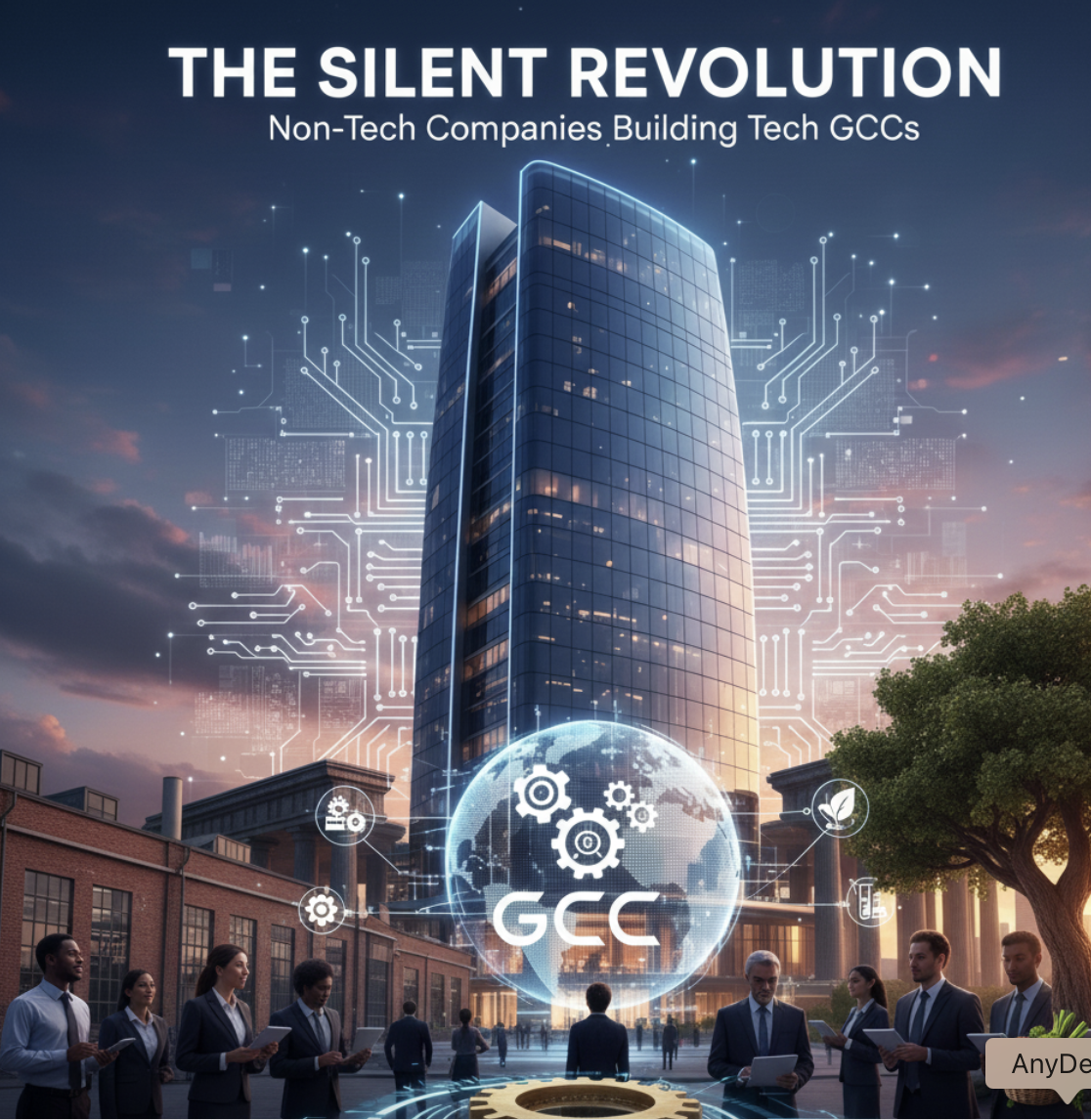
For decades, Global Capability Centers (GCCs) were largely the province of technology giants. But today, a powerful shift is underway: non‑tech companies — including manufacturers, retailers, insurers, logistics firms, and healthcare providers — are building sophisticated GCCs that rival those of pure tech firms. These companies are transforming into technology-first enterprises, and their GCCs are central to that transformation.
Why Non‑Tech Firms Are Building GCCs
Competing on technology is no longer optional. Whether it’s customer experience, supply chain optimization, predictive maintenance, or pricing engines, value increasingly comes from what you build, not what you buy. GCCs give non‑tech firms the scale, continuity, and density of talent needed to own IP, control roadmaps, and think long term.
By shifting beyond vendor models, these companies are building strategic engineering teams — purpose-built to deliver innovation, not just delivery.
From Cost Centers to Innovation Engines
The modern GCC is not just a cost arbitrage play. Instead, non‑tech companies are leveraging GCCs to:
- Access specialized talent in AI, data engineering, cloud, and cybersecurity.
- Create dedicated, mission‑driven teams rather than pull from vendor benches.
- Ensure long-term continuity, enabling iterative product thinking and experimentation.
- Build strategic ownership, making GCCs innovation hubs for their parent companies.
These centers are no longer just execution nodes – they are long-term, strategic investments.
Industries Leading the Charge
Key sectors where non‑tech companies are building cutting-edge GCCs include:
- Financial Services & Insurance: Fraud detection, claims automation, risk-scoring, and personalization platforms. (JP Morgan Chase, Allianz, Arch Capital Group)
- Retail & Consumer Brands: Demand forecasting, loyalty platforms, inventory optimization, and e-commerce innovation. (Costco, Pepsi, McDonald’s)
- Manufacturing & Automotive: Connected factories, digital twins, IoT systems, and embedded software. (Carl Zeiss AG, ZF Lifetec, Visteon)
- Healthcare & Life Sciences: Analytics platforms, R&D informatics, patient-experience systems, and AI diagnostics. (Eli Lilly, Sanofi, Amgen)
- Logistics & Infrastructure: Optimization algorithms, predictive maintenance, and AI-based supply chain intelligence. (DHL, UPS, FedEx)
In each case, GCCs empower non-tech companies to operate with the speed, discipline, and innovation mindset of a pure software company.
Why India Is the Epicenter
India has emerged as the global heart of the GCC revolution. According to the 2024 NASSCOM India GCC Landscape Report:
- Over 1,700 GCCs foreign companies run GCCs in India as of FY 2024. There are about 2,975 GCC units in India, showing that many companies operate from multiple sites.
- Those GCCs generated US$ 64.6 billion in direct salaries and infrastructure expenses.
- They employ over 1.9 million professionals.
- Notably, engineering, R&D, and transformation GCCs are growing faster than traditional delivery centers, and over 50% of GCCs now operate as portfolio or transformation hubs.
- There are ~480 mid‑market GCCs (companies with revenue between US$100 million– US$1 billion), which tend to scale faster and take on more innovation-led charters.
- Looking ahead, by 2030 India’s GCC market is projected to host 2,100–2,200 GCCs, employ 2.5–2.8 million people, and generate US$ 99–105 billion in direct salaries and infrastructure costs.
These numbers reflect not just scale, but strategic depth: GCCs in India are evolving into centers of excellence in AI, data science, cloud, and advanced engineering.
What Makes These GCCs Different from Traditional Outsourcing
Several factors distinguish modern GCCs from classic outsourcing models:
- Ownership: GCC teams are internal employees — not contractors.
- Strategic alignment: Their roadmap is tied to corporate objectives, not vendor billing cycles.
- Multi-functional structure: GCCs are structured as cross-functional pods — engineering, product, QA, analytics, and design working together.
- Long-term mandate: These are not cost-saving stopgaps; they are strategic investments with innovation at their core.
In short, non‑tech GCCs are fully integrated innovation engines, not auxiliary vendor operations.
Challenges Non‑Tech Firms Face
Despite the upside, building a GCC is not without risk:
- Cultural integration: Bridging legacy headquarters and a modern GCC requires alignment.
- Leadership gaps: Hiring senior engineering and product leaders early is critical.
- Governance risk: Without clear structures, scope and roles can become unclear.
- Transition issues: Moving from a vendor-heavy model to in-house GCC work can be complex.
- Talent retention: As GCCs mature – especially in AI – keeping top talent becomes harder.
Companies that don’t plan for these challenges often struggle in the foundational years.
Our Perspective
From our vantage point as AI-strategy and operations advisors, this non‑tech GCC wave represents a transformational lever, not just a cost play. Here’s how we recommend executives think about it:
- Define GCCs as strategic growth centers. Start with charters tied to long-term business outcomes — not just headcount or cost savings.
- Begin with a lean but high-impact structure. A smaller, transformation-focused GCC (especially in the mid-market) can scale faster and stay aligned to innovation goals.
- Invest in leadership early. Prioritize senior product and engineering hires from the outset. Their vision will set the tone.
- Build cross-functional pods. Align product, data, engineering, QA, and design to create full ownership of digital initiatives.
- Put governance in place. Treat the GCC as a P&L-sensitive unit with clear KPIs and close integration with headquarters.
- Leverage the GCC for AI. Use it to build data pipelines, run experimentation cycles, and deploy models — not just write code.
- Plan for long-term talent retention. Offer career paths, global rotations, and ownership of high-impact projects to keep top talent engaged.
If you do this, your GCC won’t just deliver — it will innovate, helping you compete as a true technology company.
Last updated: July 17th, 2026