
There is lies, damned lies and statistics. For American marketers, the image below from the new book “The Haves and the Have-Nots,” by World Bank economist Branko Milanovic can fall into the last of those categories. Milanovic sliced the income of national popultions into five percentile slices (“ventiles”), adjusted for purchasing power parity and compared various countries.
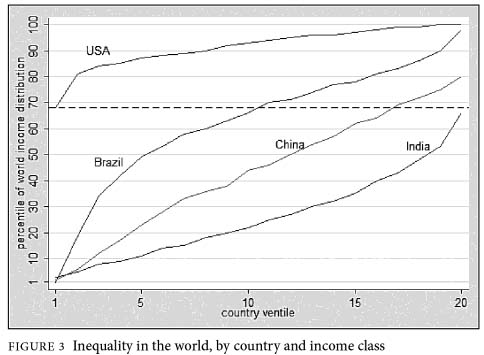
The blog on the New York Times concludes, looking at the data, “America’s bottom ventile is still richer than most of the world: That is, the typical person in the bottom 5 percent of the American income distribution is still richer than 68 percent of the world’s inhabitants. India’s poorest ventile corresponds with the 4th poorest percentile worldwide. And its richest? The 68th percentile. Yes, that’s right: America’s poorest are, as a group, about as rich as India’s richest.”
Shocking, eh?
So the poorest 5 percent of Americans, the population full of the homeless, the recently release from prison (we have the largest prison population in the the developed world), the welfare moms, the food stamp crowd are doing as well as the richest Indians. The ones you see sipping Rs 45 lattes at Cafe Coffee Day, or boasting about their vacations in Phuket, or working at IBM and Reliance. Even a casual visitor to India can tell that this can’t possibly be real.
Yes, there are 800 million destitute in India. But the consumption patterns of the top 100 million in India match American middle class patterns. Sales of homes, luxury cars, airline travellers, and other indicators clearly point to a group of consumers that are living the good life. So where is the mismatch?
Income: Fatherhood, Consumption: Motherhood
It’s likely to be between “income” and “consumption”. While a few Americans may mis-report their income, by and large very reliable income numbers are available in the United States and Western countries. On the other hand, you cannot gather accurate income information in India for a number of reasons. In surveys, middle and upper class Indians will habitually under-report their income: partly out of humility and partly because they do not want to to attract the attention of the income tax department or dozens of sundry inspectors and bureacrats who want a piece of that income. For top government employees, much of their “income” is in non-cash form, such as subsidized housing, paid vacation travel, theability to use some official cars for personal use, and so on. In my view, you are not comparing apples to apples when looking at income in the USA and comparing with India. As they say, in India income is like fatherhood, you can not easily be sure who is the father of newborn. On the other hand, consumption, that’s a fact, there is no denying who’s the mother of a new born. So Dr. Milanovic, let’s do a version that measures consumption.
In the meantime, my clients at Amritt’s Market Entry and Growth Practice are making money hand over fist, regardless of what the economists say!
Last updated: December 26th, 2025

